Peabody Museum of Salem
Also known as: East India Marine Hall; Peabody Academy of Science
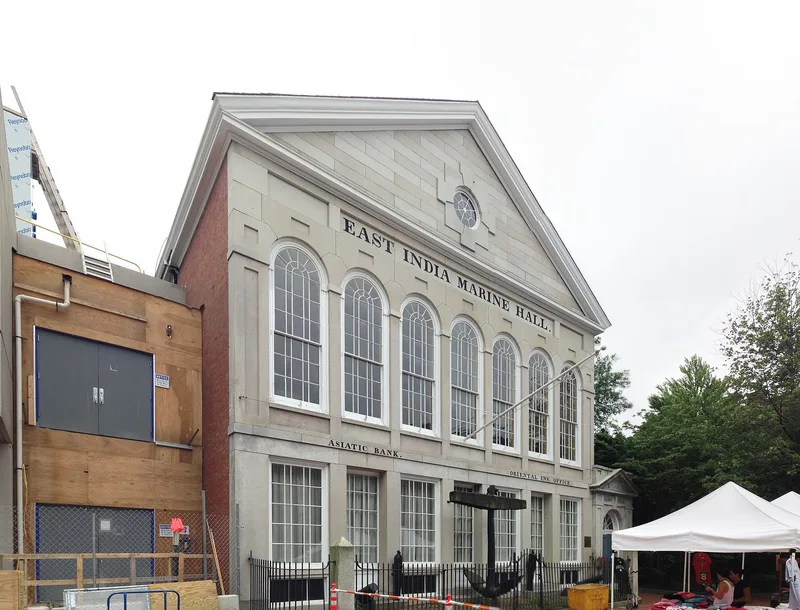

Why it's listed
East India Marine Hall was built in 1824-25 on Essex Street in Salem, Massachusetts, to house the East India Marine Society, a group of shipmasters founded in 1799. The two-story building measures about 45 by 100 feet, with a granite front and brick sides and rear. Its seven-bay facade has round-arched second-floor windows and a pedimented gable. The society's collections later passed to the Peabody Academy of Science, funded by George Peabody's 1867 gift, which remodeled the interior in 1867-69. Some original details were restored in 1943. Large additions from the late 19th century onward, including a wing dedicated in 1976, now hide much of the original block. The museum is described as the oldest continuously operated museum in the United States. Its collections cover maritime history, the ethnology of non-European peoples, and natural history, and it maintains a research library and a large photograph archive.
Significance in brief: The Peabody Museum of Salem was founded in 1799 by the East India Marine Society and is described as the oldest continuously operated museum in the United States. East India Marine Hall, dedicated in 1825, was the first structure built specifically for the organization. The museum carried on the society's educational purpose and holds maritime, ethnological and natural history collections.
Machine-generated summary. This summary was generated by a language model from the official nomination document and has not been reviewed line by line by an editor. It may contain errors. Check the source document before relying on any detail. Source: nomination document (PDF) · National Archives catalog entry. NRHP reference 66000783, listed October 15, 1966. Summary generated October 2026 (model claude-sonnet-5-5, prompt v1.0-2026-10-29, confidence medium).
Key facts
| Address | 161 Essex St., Salem |
|---|---|
| County | Essex County |
| Listed | October 15, 1966 |
| Reference number | 66000783 |
| Resource type | Building |
| Architect / builder | Not Known |
| Areas of significance | Education |
| Level of significance | National |
| National Historic Landmark | Yes, designated December 21, 1965 |
| Status (as stated in the nomination) | Condition marked excellent; in use as a museum, with additions dedicated in 1976. |
| Acreage | 1 |
| Coordinates | 42.52159, -70.89236 (NPS GIS) |
What listing means for this property
National Register listing is honorary: it recognises significance and does not restrict what a private owner may do without federal money or permits. It unlocks the 20% federal rehabilitation tax credit for income-producing buildings, state credits in many states, and Section 106 review when federal agencies are involved. See what listing means in practice.
General information, not legal or tax advice. Rules change; confirm with your State Historic Preservation Office or a qualified adviser.
Sources and further reading
- National Park Service, National Register of Historic Places database (snapshot May 2026), reference 66000783.
- Nomination form (PDF, National Archives) — catalog entry
- Wikipedia article (used for cross-checking only; text not reproduced here)
- Wikidata Q12065452
- This listing as JSON
Last updated October 2026. Found an error? See the editorial policy for how to report it.