Grace Episcopal Church

Why it's listed
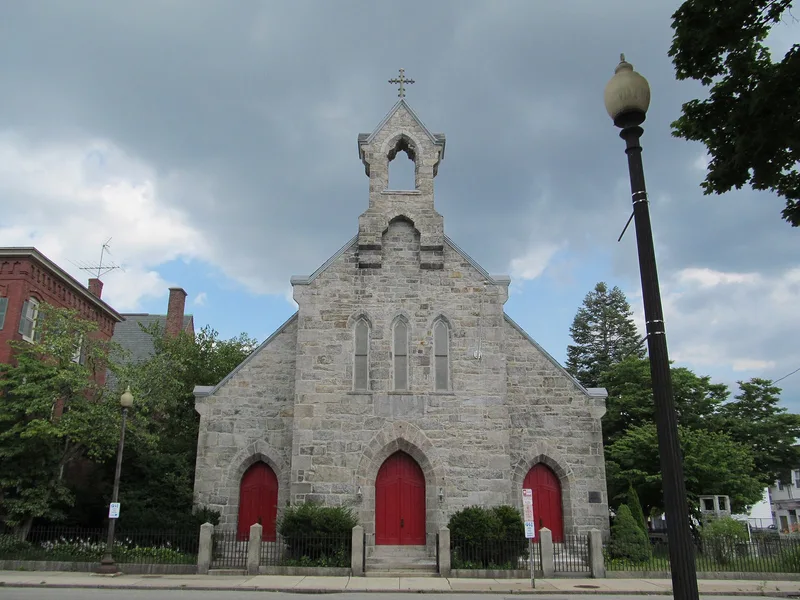
Grace Episcopal Church occupies a half-acre corner lot facing the Common in Lawrence, Massachusetts. Built in 1851 and dedicated in 1852, it is a simple rectangular auditorium of random ashlar stone with a gabled front, three pointed-arch entrances, three lancet windows over the center bay, and a stone bell housing at the gable peak. A one-story addition came in 1895, when the young firm of Cram, Wentworth, and Goodhue drew plans for a new chancel and side wings. A Tudor Revival parish house was added in 1929, with a contemporary base added in 1958. The parish was founded in October 1846, five months before the town was established, and the first wooden chapel was designed by Hammatt and Joseph Billings of Boston. Members of the Lawrence family, for whom the town is named, served as rectors and curates, and several clergy became Episcopal bishops. Cram and Ferguson later produced interior work including choir stalls, sacristy and organ.
Significance in brief: The church was founded in 1846, five months before Lawrence was established as a town, and is tied to the Lawrence family, for whom the town was named and several of whom served as clergy and later bishops. It is also significant architecturally for its association with Hammatt Billings and with Ralph Adams Cram's firms, which enlarged and furnished it.
Machine-generated summary. This summary was generated by a language model from the official nomination document and has not been reviewed line by line by an editor. It may contain errors. Check the source document before relying on any detail. Source: nomination document (PDF) · National Archives catalog entry. NRHP reference 76001966, listed November 7, 1976. Summary generated October 2026 (model claude-sonnet-5-5, prompt v1.0-2026-10-29, confidence medium).
Key facts
| Address | Common and Jackson Sts., Lawrence |
|---|---|
| County | Essex County |
| Listed | November 7, 1976 |
| Reference number | 76001966 |
| Resource type | Building |
| Period of significance | 1800-1899 |
| Architect / builder | Hammatt Billings, Ralph A. Cram |
| Architectural style | Gothic (Tudor Revival parish house) |
| Areas of significance | Architecture, Religion |
| Level of significance | Local |
| Status (as stated in the nomination) | Occupied and in use as a church; marked as altered. |
| Acreage | 0.5 |
| Coordinates | 42.70879, -71.15748 (NPS GIS) |
What listing means for this property
Religious properties are listed for their architectural or historical significance, not their religious use. Listing is honorary and does not restrict the congregation's use of the building. The federal rehabilitation credit is generally unavailable unless part of the building is income-producing; some state programmes and preservation grants do cover religious buildings. Federal funding or permits trigger Section 106 review.
General information, not legal or tax advice. Rules change; confirm with your State Historic Preservation Office or a qualified adviser.
Sources and further reading
- National Park Service, National Register of Historic Places database (snapshot May 2026), reference 76001966.
- Nomination form (PDF, National Archives) — catalog entry
- Wikipedia article (used for cross-checking only; text not reproduced here)
- Wikidata Q5591125
- This listing as JSON
Last updated October 2026. Found an error? See the editorial policy for how to report it.