First Unitarian Church
Also known as: Park Square Church

Why it's listed
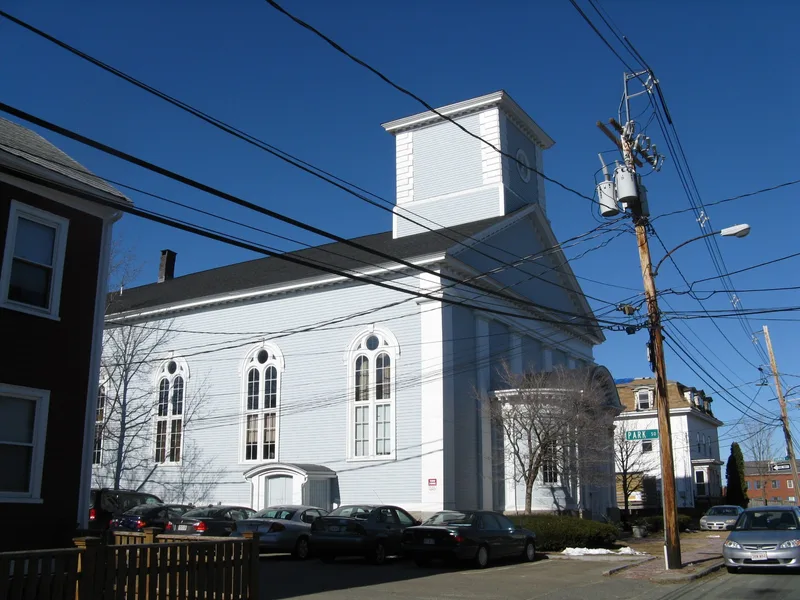
Built in 1826 at Park Square in Peabody, this wooden church began as a classic New England meeting house with a temple front and a three-stage steeple. A Unitarian congregation formed in 1825 and paid for it through pew subscriptions, with local tanning merchants among its supporters. A chapel was added at the rear in 1868-69, and in 1872 a costly renovation recast the building in the Italianate style, adding a sculptural entry porch, enclosing the original portico and rebuilding the interior. A small north porch followed in 1927, and a 1939 restoration gave the exterior its white meetinghouse look. As Peabody's population changed, the congregation shrank, merged with Universalists, and moved to a new church in Danvers in 1967. The upper steeple was then removed, and the empty building has since deteriorated. It is considered significant for its link to local Unitarian history and as the oldest surviving church building in Peabody.
Significance in brief: The nomination argues the church is historically tied to the growth of Unitarianism in Peabody and the North Shore well into the 20th century. It is also significant architecturally for its Greek Revival and Italianate detailing. It is described as the oldest surviving ecclesiastical building in Peabody.
Machine-generated summary. This summary was generated by a language model from the official nomination document and has not been reviewed line by line by an editor. It may contain errors. Check the source document before relying on any detail. Source: nomination document (PDF) · National Archives catalog entry. NRHP reference 88001091, listed September 18, 1989. Summary generated October 2026 (model claude-sonnet-5-5, prompt v1.0-2026-10-29, confidence high).
Key facts
| Address | 7 Park St., Peabody |
|---|---|
| County | Essex County |
| Listed | September 18, 1989 |
| Reference number | 88001091 |
| Resource type | Building |
| Period of significance | 1826-1939 |
| Architectural style | Greek Revival; Italianate |
| Criteria |
|
| Areas of significance | Architecture |
| Level of significance | Local |
| Status (as stated in the nomination) | Vacated in 1967 when the congregation moved to Danvers; the steeple's upper stages were removed and the interior has suffered water damage. Current function is listed as multiple dwelling, condominiums. |
| Acreage | 0.9 |
| Coordinates | 42.52452, -70.92662 (NPS GIS) |
What listing means for this property
Religious properties are listed for their architectural or historical significance, not their religious use. Listing is honorary and does not restrict the congregation's use of the building. The federal rehabilitation credit is generally unavailable unless part of the building is income-producing; some state programmes and preservation grants do cover religious buildings. Federal funding or permits trigger Section 106 review.
General information, not legal or tax advice. Rules change; confirm with your State Historic Preservation Office or a qualified adviser.
Sources and further reading
- National Park Service, National Register of Historic Places database (snapshot May 2026), reference 88001091.
- Nomination form (PDF, National Archives) — catalog entry
- Wikipedia article (used for cross-checking only; text not reproduced here)
- Wikidata Q5453943
- This listing as JSON
Last updated October 2026. Found an error? See the editorial policy for how to report it.