Davis-Freeman House
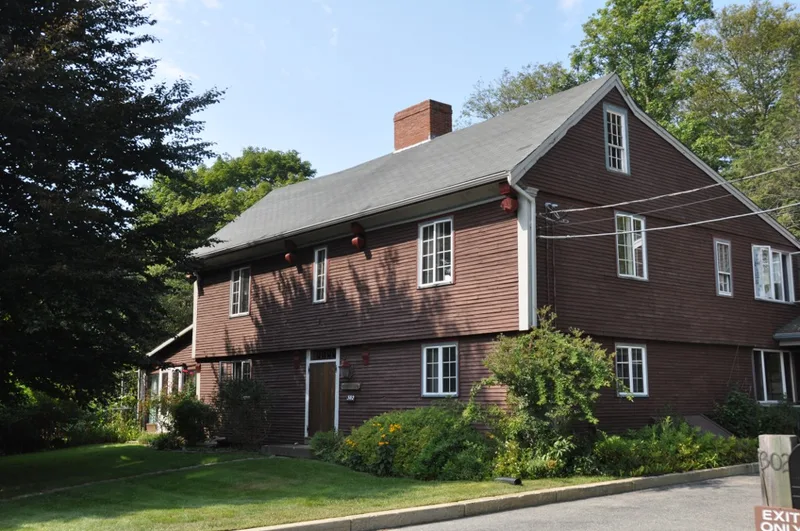

Why it's listed
Built between about 1709 and 1712 beside the Little River in Gloucester, this two-and-one-half-story clapboarded house is a rare example of plank frame construction in northern Essex County. Davis family members ran a saw mill nearby, and the availability of sawn planks may have influenced the choice of frame. The exposed braces on the chamber walls, hewn overhangs and six molded post heads below the overhang show careful craftsmanship. Inside, a squat turned newel post, a deeply molded handrail and door frames shaped from the edges of sheathing boards mark the shift from First Period to Second Period styles. The house served as a tavern for most of the 18th century. From about 1860 to 1929 it belonged to Robin Freeman, who had escaped slavery in South Carolina, and his descendants. In the 1930s antique dealers restored it as the Stage Coach Inn, adding leaded casement windows. Since 1981 it has housed a shelter for the homeless.
Significance in brief: The nomination argues the house meets criterion C for its distinctive plank frame construction and finely crafted decorated frame, including rare surviving molded post heads below the overhang. It also has transitional First to Second Period trim in the stair lobby. The house is further noted as an example of early 20th-century restoration practice.
Machine-generated summary. This summary was generated by a language model from the official nomination document and has not been reviewed line by line by an editor. It may contain errors. Check the source document before relying on any detail. Source: nomination document (PDF) · National Archives catalog entry. NRHP reference 90000214, listed March 9, 1990. Summary generated October 2026 (model claude-sonnet-5-5, prompt v1.0-2026-10-29, confidence high).
Key facts
| Address | 302 Essex St., Gloucester |
|---|---|
| County | Essex County |
| Listed | March 9, 1990 |
| Reference number | 90000214 |
| Resource type | Building |
| Architectural style | First Period |
| Criteria |
|
| Areas of significance | Architecture |
| Level of significance | State |
| Status (as stated in the nomination) | Condition described as good; in use since 1981 as a shelter for the homeless called Wellspring. |
| Acreage | 1.7 |
| Coordinates | 42.61074, -70.70837 (NPS GIS) |
What listing means for this property
National Register listing is honorary for a privately owned home: it does not by itself restrict what an owner may do with their own money, and it does not require public access. Restrictions come from local landmark or historic-district ordinances, which are separate (how they differ).
Owner-occupied houses are not eligible for the 20% federal rehabilitation tax credit, which applies to income-producing buildings, but many states offer credits for homeowners. Listing also opens the door to preservation easements and to buying a plaque. Start with what listing means for homeowners, renovating a listed house and selling one.
General information, not legal or tax advice. Rules change; confirm with your State Historic Preservation Office or a qualified adviser.
Sources and further reading
- National Park Service, National Register of Historic Places database (snapshot May 2026), reference 90000214.
- Nomination form (PDF, National Archives) — catalog entry
- Wikipedia article (used for cross-checking only; text not reproduced here)
- Wikidata Q5241816
- This listing as JSON
Last updated October 2026. Found an error? See the editorial policy for how to report it.