Bridge Street Neck Historic District

Why it's listed
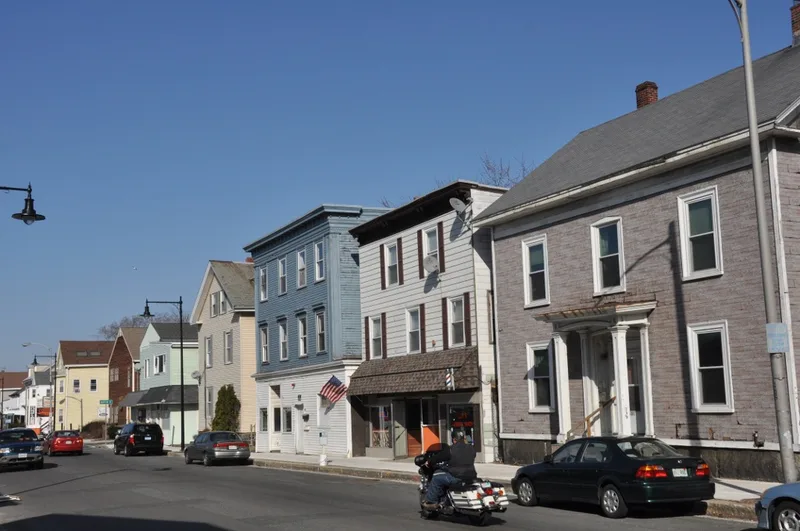
Bridge Street Neck is a compact neighborhood in Salem, Massachusetts, on a level peninsula between the North River and Collins Cove. Bridge Street forms its spine and long served as the route to the ferry and, after 1788-89, the Beverly Bridge, later carrying streetcars. The district contains 382 contributing buildings dating from about 1780 to about 1952, nearly all of wood-frame construction. Federal-period three-story hip-roofed houses built for sea captains and merchants, such as the Jacob Lord House of 1808, stand alongside gambrel-roofed dwellings, Greek Revival temple-front houses, and later Italianate, Second Empire and Queen Anne buildings. Over the 19th century the area also housed workers employed in jute, leather and lead factories, railroad car barns and shops, and a shoe factory. Greenhouses and the large gardens of George Dean Phippen reflected its semi-rural edge. Most commercial buildings lie along Bridge Street, and the district keeps its overall character despite alterations such as replacement siding and windows.
Significance in brief: The district shows how a neighborhood grew from sea captains' and merchants' homes into a mixed working-class area tied to maritime trades, railroads and factories. It keeps a wide range of Georgian, Federal, Greek Revival and later Victorian houses. Bridge Street was also an early route to the Beverly ferry and bridge and later carried streetcars.
Machine-generated summary. This summary was generated by a language model from the official nomination document and has not been reviewed line by line by an editor. It may contain errors. Check the source document before relying on any detail. Source: nomination document (PDF) · National Archives catalog entry. NRHP reference 02000790, listed July 19, 2002. Summary generated October 2026 (model claude-sonnet-5-5, prompt v1.0-2026-10-29, confidence medium).
Key facts
| Address | Bridge St., and side Sts. bet. March/Osgood Sts., and Howard/Webb Sts., Salem |
|---|---|
| County | Essex County |
| Listed | July 19, 2002 |
| Reference number | 02000790 |
| Resource type | District |
| Architectural style | Colonial: Georgian; Mid 19th Century: Greek Revival; Late Victorian: Italianate, Second Empire, Queen Anne |
| Areas of significance | Architecture, Community Planning and Development |
| Level of significance | Local |
| Status (as stated in the nomination) | Mostly residential with commercial buildings along Bridge Street; industrial uses have nearly vanished. Many wood-frame buildings have synthetic siding. |
| Acreage | 80 |
| Coordinates | 42.52917, -70.88974 (NPS GIS) |
What listing means for this property
This is a historic district. Buildings within its boundary are either contributing (they add to the district's significance) or non-contributing. Owners of contributing income-producing buildings can claim the 20% federal rehabilitation tax credit; homeowners should look at state credits. National Register districts impose no design review by themselves; a local historic district ordinance, if one exists, does (the difference explained).
General information, not legal or tax advice. Rules change; confirm with your State Historic Preservation Office or a qualified adviser.
Sources and further reading
- National Park Service, National Register of Historic Places database (snapshot May 2026), reference 02000790.
- Nomination form (PDF, National Archives) — catalog entry
- Wikipedia article (used for cross-checking only; text not reproduced here)
- Wikidata Q4966308
- This listing as JSON
Last updated October 2026. Found an error? See the editorial policy for how to report it.