Whittenton Mills Complex

Why it's listed
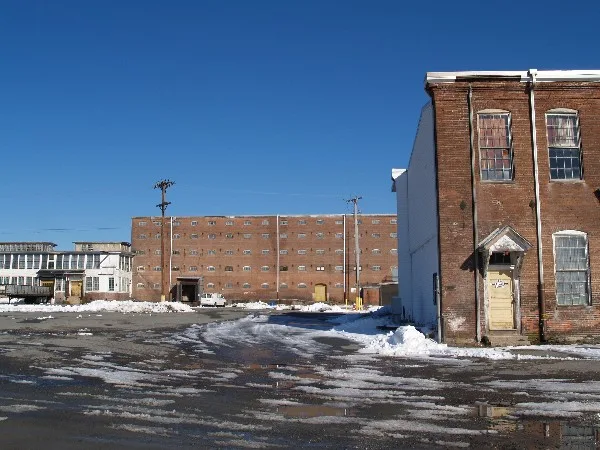
Whittenton Mills is a group of brick and frame textile factories beside the Mill River in Taunton, Massachusetts. The site began with a 1669 iron forge and a nail factory built in 1805 that was later converted to cotton spinning. Slater looms arrived by 1817, bringing full-scale weaving. Willard Lovering came in 1836, and he and his sons bought the mills in 1858, then expanded the complex to some twenty brick buildings making ginghams, tickings, shirtings and flannels. Water wheels and Corliss steam engines supplied power. In the 1880s and 1890s about 1,100 people worked there, many of them French Canadian weavers and dyers living in company-owned tenements nearby. The Lovering family ran the business until 1910, and the company housing was sold in the 1920s. Surviving buildings include a c. 1880 weaving mill with 41 bays on Whittenton Street, picker buildings from about 1878, and a c. 1895 five-story storehouse. The complex was listed for its role in Taunton's manufacturing history and its intact industrial character.
Significance in brief: The complex is argued to be significant as the largest and longest-lived textile manufacturer in Taunton, tied to industrial pioneers Samuel Crocker and Willard Lovering. Its growth reflects the city's 19th-century industrial expansion and the French Canadian immigration that shaped the Whittenton community. It is described as retaining integrity and as an example of a planned industrial village.
Machine-generated summary. This summary was generated by a language model from the official nomination document and has not been reviewed line by line by an editor. It may contain errors. Check the source document before relying on any detail. Source: nomination document (PDF) · National Archives catalog entry. NRHP reference 84002275, listed July 5, 1984. Summary generated October 2026 (model claude-sonnet-5-5, prompt v1.0-2026-10-29, confidence high).
Key facts
| Address | Mill River and Whittenton St., Taunton |
|---|---|
| County | Bristol County |
| Listed | July 5, 1984 |
| Reference number | 84002275 |
| Resource type | Building |
| Period of significance | 1805-c. 1895 |
| Criteria |
|
| Areas of significance | Industry, Architecture |
| Level of significance | Local |
| Status (as stated in the nomination) | Described as in good condition and in industrial and commercial use; one company occupies a large portion of the buildings and leases the remaining space to tenant industries. |
| Acreage | 20 |
| Coordinates | 41.92479, -71.10566 (NPS GIS) |
What listing means for this property
National Register listing is honorary: it recognises significance and does not restrict what a private owner may do without federal money or permits. It unlocks the 20% federal rehabilitation tax credit for income-producing buildings, state credits in many states, and Section 106 review when federal agencies are involved. See what listing means in practice.
General information, not legal or tax advice. Rules change; confirm with your State Historic Preservation Office or a qualified adviser.
Sources and further reading
- National Park Service, National Register of Historic Places database (snapshot May 2026), reference 84002275.
- Nomination form (PDF, National Archives) — catalog entry
- Wikipedia article (used for cross-checking only; text not reproduced here)
- Wikidata Q7996854
- This listing as JSON
Last updated October 2026. Found an error? See the editorial policy for how to report it.