Taunton Green Historic District

Why it's listed
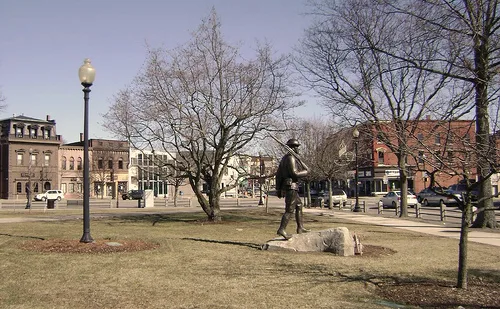
Taunton Green and the buildings around it form the historic heart of Taunton, Massachusetts. The district covers about five acres and includes the city's main public park along with continuous rows of multi-story masonry commercial buildings on Main Street, Broadway and Court Street. The Green was granted to the town as a training field in 1743, and the first Liberty and Union flag was raised there in 1774. Federal-style stores and hotels from about 1830 stand beside the Renaissance Revival Bank Block of about 1855, the Union Block of 1860, the Jones and Taylor Blocks, the Crocker Building of 1900, and bank additions of 1893 and 1913. A Neoclassical post office built in 1931 replaced an earlier Romanesque one. A granite and iron fence from 1840-41 encloses the Green, which holds monuments to Shays' Rebellion and to several wars. The district was listed for its architecture and its link to Taunton's commercial and industrial growth.
Significance in brief: The district contains the city's major public park and its finest 19th and early 20th century masonry commercial architecture. These buildings reflect Taunton's rise as a commercial and manufacturing center and the aspirations of its merchants, industrialists and financiers. The Green has also been the seat of public affairs since the mid-18th century. The form states that it meets criteria A, B and C.
Machine-generated summary. This summary was generated by a language model from the official nomination document and has not been reviewed line by line by an editor. It may contain errors. Check the source document before relying on any detail. Source: nomination document (PDF) · National Archives catalog entry. NRHP reference 85000547, listed March 1, 1985. Summary generated October 2026 (model claude-sonnet-5-5, prompt v1.0-2026-10-29, confidence medium).
Key facts
| Address | Broadway, Taunton Green, Main and Court Sts., Taunton |
|---|---|
| County | Bristol County |
| Listed | March 1, 1985 |
| Reference number | 85000547 |
| Resource type | District |
| Period of significance | c. 1830-1930 |
| Architectural style | Federal through Classical Revival, including Renaissance Revival, Victorian Italianate, Neoclassical, Beaux Arts and Richardsonian Romanesque |
| Criteria |
|
| Areas of significance | Commerce, Architecture |
| Level of significance | Local |
| Status (as stated in the nomination) | Contributing buildings retain design integrity; a few 20th century buildings, including one-story storefronts and a vacant lot, are non-contributing. The Green is surrounded by a fence from 1840-41 and holds four monuments. |
| Acreage | 5 |
| Coordinates | 41.90222, -71.09318 (NPS GIS) |
What listing means for this property
This is a historic district. Buildings within its boundary are either contributing (they add to the district's significance) or non-contributing. Owners of contributing income-producing buildings can claim the 20% federal rehabilitation tax credit; homeowners should look at state credits. National Register districts impose no design review by themselves; a local historic district ordinance, if one exists, does (the difference explained).
General information, not legal or tax advice. Rules change; confirm with your State Historic Preservation Office or a qualified adviser.
Sources and further reading
- National Park Service, National Register of Historic Places database (snapshot May 2026), reference 85000547.
- Nomination form (PDF, National Archives) — catalog entry
- Wikipedia article (used for cross-checking only; text not reproduced here)
- Wikidata Q7688790
- This listing as JSON
Last updated October 2026. Found an error? See the editorial policy for how to report it.