Morse House

Why it's listed
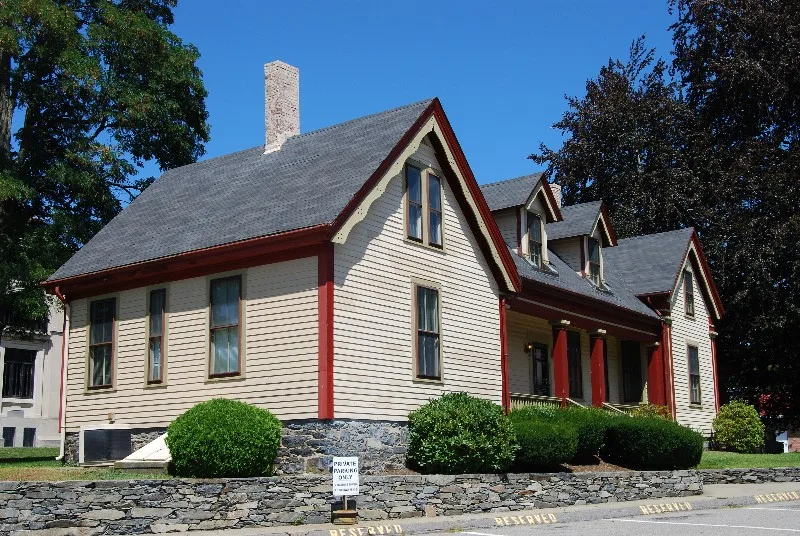
Built around 1850 at 6 Pleasant Street in Taunton, this small clapboard house is notable for blending two architectural movements. Its asymmetrical exterior, with brackets, porches and gable dormers, reflects Gothic Revival cottage design, while the interior keeps Greek Revival detailing, including an impressive staircase and marble fireplaces. The house shows the transition from Classical architecture to the Romantic period and is described as Taunton's fine example of Gothic Revival cottage form. Little is known about its origins or original owner. From the 1860s through the late 1880s it was occupied by Mrs. N.W. Hall, a milliner who ran a shop at 52 Main Street. A fire in 1980 caused damage, yet the key interior finishes survived, and the house was vacant when documented. A rehabilitation for office use following federal preservation standards was planned. It was listed for its architectural merit.
Significance in brief: The nomination presents it as Taunton's fine example of Gothic Revival architecture in cottage form. It also shows the shift from Classical Greek Revival to the Romantic Gothic Revival. It has detailed exterior and interior finishes and retains integrity of location, design, setting, materials, workmanship and association.
Machine-generated summary. This summary was generated by a language model from the official nomination document and has not been reviewed line by line by an editor. It may contain errors. Check the source document before relying on any detail. Source: nomination document (PDF) · National Archives catalog entry. NRHP reference 84002185, listed July 5, 1984. Summary generated October 2026 (model claude-sonnet-5-5, prompt v1.0-2026-10-29, confidence medium).
Key facts
| Address | 6 Pleasant St., Taunton |
|---|---|
| County | Bristol County |
| Listed | July 5, 1984 |
| Reference number | 84002185 |
| Resource type | Building |
| Architectural style | Greek Revival/Carpenter Gothic |
| Criteria |
|
| Areas of significance | Architecture |
| Level of significance | Local |
| Status (as stated in the nomination) | Listed as vacant. A fire in 1980 altered it, but the most significant interior finishes remain intact. A rehabilitation for office use was planned. |
| Acreage | 0.9 |
| Coordinates | 41.90414, -71.09410 (NPS GIS) |
What listing means for this property
National Register listing is honorary for a privately owned home: it does not by itself restrict what an owner may do with their own money, and it does not require public access. Restrictions come from local landmark or historic-district ordinances, which are separate (how they differ).
Owner-occupied houses are not eligible for the 20% federal rehabilitation tax credit, which applies to income-producing buildings, but many states offer credits for homeowners. Listing also opens the door to preservation easements and to buying a plaque. Start with what listing means for homeowners, renovating a listed house and selling one.
Noted as vacant in the nomination. Nomination documents can be decades old; current status may differ. If you are considering buying an empty listed property, read the due-diligence checklist.
General information, not legal or tax advice. Rules change; confirm with your State Historic Preservation Office or a qualified adviser.
Sources and further reading
- National Park Service, National Register of Historic Places database (snapshot May 2026), reference 84002185.
- Nomination form (PDF, National Archives) — catalog entry
- Wikipedia article (used for cross-checking only; text not reproduced here)
- Wikidata Q6914257
- This listing as JSON
Last updated October 2026. Found an error? See the editorial policy for how to report it.