Charlton Mill

Why it's listed
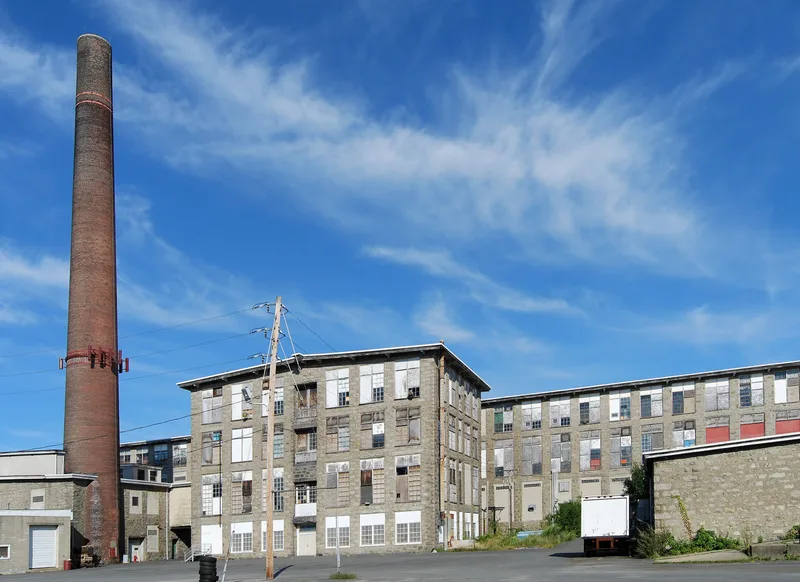
Charlton Mill is a granite cotton mill complex at 109 Howe Street in Fall River, near Globe Village and the west side of Cook Pond. Built in 1911 on twelve acres, it was the last granite mill constructed in the city, using stone quarried on the site. The three-story spinning mill measures 154 by 374 feet and has a shallow roof, a six-aisle plan and large windows. An engine and picker house, an attached boiler house and a chimney complete the surviving complex, while the large weave shed has been demolished. William T. Henry, a prolific local mill engineer, designed it, and Chauncey Sears served as mason and contractor. The mill was the last of eight fine goods mills built between 1907 and 1911, the final profitable years before Fall River's cotton textile collapse. It was named for financier E.P. Charlton and used both steam and electrical power. Textile production continued there into the 1980s.
Significance in brief: It was the last granite mill built in Fall River and is presented as the ultimate refinement of cotton textile mill design, with extreme width and large window area. It retains integrity of design, materials, workmanship and setting. It is also tied to the final profitable boom years of Fall River's cotton industry, and it meets Criteria A and C.
Machine-generated summary. This summary was generated by a language model from the official nomination document and has not been reviewed line by line by an editor. It may contain errors. Check the source document before relying on any detail. Source: nomination document (PDF) · National Archives catalog entry. NRHP reference 83000650, listed February 16, 1983. Summary generated October 2026 (model claude-sonnet-5-5, prompt v1.0-2026-10-29, confidence medium).
Key facts
| Address | 109 Howe St., Fall River |
|---|---|
| County | Bristol County |
| Listed | February 16, 1983 |
| Reference number | 83000650 |
| Resource type | Building |
| Period of significance | 1911 |
| Architect / builder | William T. Henry, mill engineer; Chauncey Sears, mason and contractor |
| Criteria |
|
| Areas of significance | Industry, Architecture |
| Level of significance | State |
| Status (as stated in the nomination) | Still in textile production at the time of the form (1981); the large weave shed has been demolished. |
| Acreage | 22.8 |
| Coordinates | 41.67866, -71.17683 (NPS GIS) |
What listing means for this property
For an income-producing building, listing (individually or as a contributing building in a district) is the gateway to the 20% federal rehabilitation tax credit on qualified rehabilitation costs, often stackable with state credits. Work claiming the credit must follow the Secretary of the Interior's Standards and be approved in advance.
Listing does not restrict a private owner acting without federal money or permits; where federal funding or licensing is involved, Section 106 review applies.
General information, not legal or tax advice. Rules change; confirm with your State Historic Preservation Office or a qualified adviser.
Sources and further reading
- National Park Service, National Register of Historic Places database (snapshot May 2026), reference 83000650.
- Nomination form (PDF, National Archives) — catalog entry
- Wikipedia article (used for cross-checking only; text not reproduced here)
- Wikidata Q5086320
- This listing as JSON
Last updated October 2026. Found an error? See the editorial policy for how to report it.