Buttonwood Park Historic District

Why it's listed
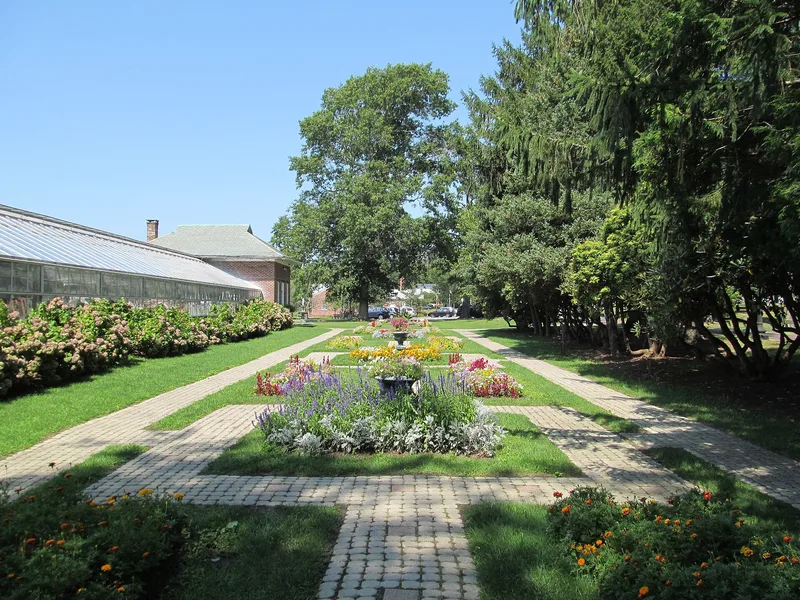
Buttonwood Park Historic District covers about 113 acres in western New Bedford, Massachusetts. Its focal point is Buttonwood Park, first planned in the 1890s by Charles Eliot of Olmsted, Olmsted and Eliot as a naturalistic landscape of woodland edges and open lawn. Over time the park gained a pond dam and causeway, a greenhouse and formal garden, a zoo, and Depression-era works such as the brick warming house, a rustic fieldstone wall along Kempton Street and a fieldstone bear den. The Barnard Monument of 1914, by sculptor George Julian Zolnay, honors the city's shift from whaling to manufacturing. Around the park lies a cohesive neighborhood of moderately scaled houses built concurrently with it, with Colonial Revival and Craftsman styles especially well represented, along with small garages reflecting the growing role of the automobile. The district includes 271 contributing resources and retains strong integrity to its 1892-1950 period of significance.
Significance in brief: The park reflects a century of park development themes: pastoral landscape design, recreation, a zoo, public horticulture, Depression-era public works and memorials. The surrounding neighborhood is an unusually cohesive turn-of-the-century residential area with strong Colonial Revival and Craftsman examples, and it developed alongside the park. The district retains a high level of integrity to its 1892-1950 period of significance.
Machine-generated summary. This summary was generated by a language model from the official nomination document and has not been reviewed line by line by an editor. It may contain errors. Check the source document before relying on any detail. Source: nomination document (PDF) · National Archives catalog entry. NRHP reference 00000915, listed August 24, 2000. Summary generated October 2026 (model claude-sonnet-5-5, prompt v1.0-2026-10-29, confidence medium).
Key facts
| Address | Kempton St., Rockdale Ave., Hawthorne St. and Brownell Ave., New Bedford |
|---|---|
| County | Bristol County |
| Listed | August 24, 2000 |
| Reference number | 00000915 |
| Resource type | District |
| Period of significance | 1892-1950 |
| Architect / builder | Charles Eliot (Olmsted, Olmsted and Eliot); Nat C. Smith; Browne and Poole; Everett T. Blossom; Labrode & Bullard; Cal B. Poulin; William F. Williams; George Julian Zolnay; Harold Kenworthy |
| Architectural style | Colonial Revival, Bungalow/Craftsman, Queen Anne, Tudor Revival, No Style (Four Square, Cape, Contemporary, Ranch) |
| Areas of significance | Architecture, Community Planning and Development, Entertainment/Recreation, Landscape Architecture |
| Level of significance | Local |
| Status (as stated in the nomination) | Park and neighborhood remain in use; the park hosts recreation, a municipal zoo, a greenhouse, a senior center and veterans facilities, and many older zoo buildings have been demolished. |
| Acreage | 113 |
| Coordinates | 41.63269, -70.95182 (NPS GIS) |
What listing means for this property
This is a historic district. Buildings within its boundary are either contributing (they add to the district's significance) or non-contributing. Owners of contributing income-producing buildings can claim the 20% federal rehabilitation tax credit; homeowners should look at state credits. National Register districts impose no design review by themselves; a local historic district ordinance, if one exists, does (the difference explained).
General information, not legal or tax advice. Rules change; confirm with your State Historic Preservation Office or a qualified adviser.
Sources and further reading
- National Park Service, National Register of Historic Places database (snapshot May 2026), reference 00000915.
- Nomination form (PDF, National Archives) — catalog entry
- Wikipedia article (used for cross-checking only; text not reproduced here)
- Wikidata Q5003119
- This listing as JSON
Last updated October 2026. Found an error? See the editorial policy for how to report it.