Mission House

Why it's listed
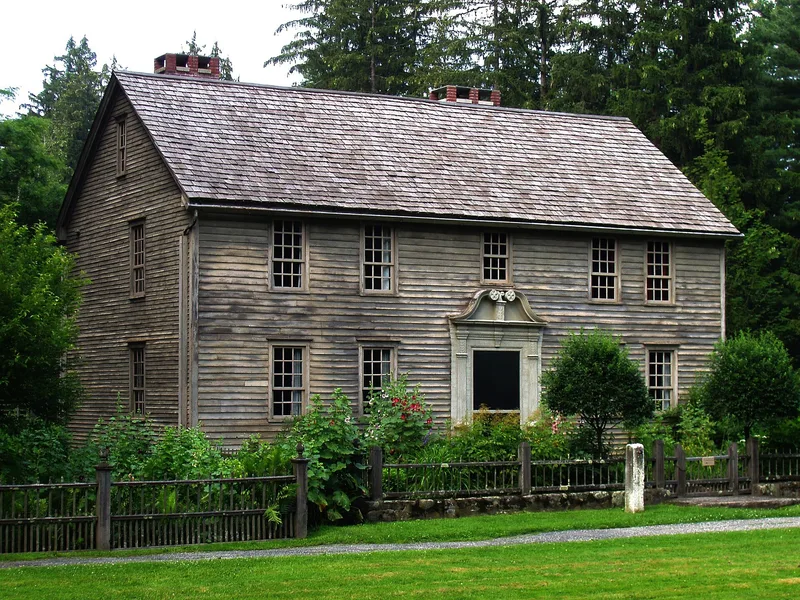
Built in 1739, the Mission House in Stockbridge, Massachusetts, was the home of the Reverend John Sergeant, the first missionary to the Housatonic Indians, and his bride, Abigail Williams. The two-and-a-half story frame and clapboard house follows a Georgian center-hall plan, with a Connecticut Valley doorway on its five-bay front and chimneys set unusually toward the rear. Sergeant adapted the layout for his work: a small study behind the parlor and a long rear hall with its own eastern entrance let Indians reach his office without passing through the family rooms. Sergeant's family lived there until 1870, and the house was sold in 1879. By 1928 it was unoccupied and badly in need of repair. It was then taken down in numbered pieces and reconstructed on Main Street, furnished with mid-eighteenth century pieces. Since 1948 the Trustees of Reservations have maintained it and opened it to visitors, alongside gardens and small visitor buildings.
Significance in brief: It survives as a physical reminder of New England colonists' early missionary work among the Housatonic Indians. Sergeant built it as a home for his bride, Abigail Williams, and modified the center-hall plan with a rear study and a separate rear hall so Indians could reach his office without passing through the main rooms. It is also a little-altered example of Georgian architecture on the New England frontier.
Machine-generated summary. This summary was generated by a language model from the official nomination document and has not been reviewed line by line by an editor. It may contain errors. Check the source document before relying on any detail. Source: nomination document (PDF) · National Archives catalog entry. NRHP reference 68000038, listed November 24, 1968. Summary generated October 2026 (model claude-sonnet-5-5, prompt v1.0-2026-10-29, confidence high).
Key facts
| Address | Main St., Stockbridge |
|---|---|
| County | Berkshire County |
| Listed | November 24, 1968 |
| Reference number | 68000038 |
| Resource type | Building |
| Period of significance | 18th Century (1739) |
| Architect / builder | Reverend John Sergeant |
| Architectural style | Georgian |
| Areas of significance | Architecture |
| Level of significance | National |
| National Historic Landmark | Yes, designated November 24, 1968 |
| Status (as stated in the nomination) | Maintained in excellent condition by the Trustees of Reservations and open to visitors as a museum; the house was dismantled and reconstructed on its present site in 1928. |
| Acreage | 0.4 |
| Within district | Main Street Historic District (Additional Documentation) |
| Coordinates | 42.28347, -73.31581 (NPS GIS) |
What listing means for this property
National Register listing is honorary for a privately owned home: it does not by itself restrict what an owner may do with their own money, and it does not require public access. Restrictions come from local landmark or historic-district ordinances, which are separate (how they differ).
Owner-occupied houses are not eligible for the 20% federal rehabilitation tax credit, which applies to income-producing buildings, but many states offer credits for homeowners. Listing also opens the door to preservation easements and to buying a plaque. Start with what listing means for homeowners, renovating a listed house and selling one.
General information, not legal or tax advice. Rules change; confirm with your State Historic Preservation Office or a qualified adviser.
Sources and further reading
- National Park Service, National Register of Historic Places database (snapshot May 2026), reference 68000038.
- Nomination form (PDF, National Archives) — catalog entry
- Wikipedia article (used for cross-checking only; text not reproduced here)
- Wikidata Q6878618
- This listing as JSON
Last updated October 2026. Found an error? See the editorial policy for how to report it.