Hancock Shaker Village

Why it's listed
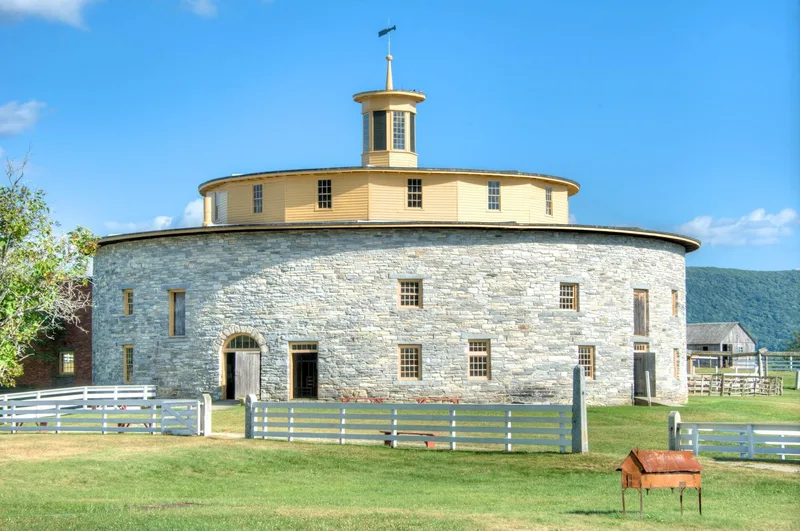
Hancock Shaker Village occupies roughly 1,000 acres on the Hancock and Pittsfield line in western Massachusetts. It preserves the Church Family core of a Shaker community organized in 1790-92 and dissolved in 1960. Nineteen original buildings survive, among them the 1830 Brick Dwelling that housed 100 members, the Brethren's Shop, the Sisters Shop, the Tan House and a 1793 meeting house moved from Shirley in 1962. The best-known structure is the Round Stone Barn, a fieldstone cylinder 95 feet across, rebuilt inside after a fire in 1864 and believed to be the first round barn in the country. The community peaked in the four decades after 1820, reaching about 300 members, then declined after the Civil War. A nonprofit corporation bought the buildings, furnishings and land in 1960, restored fourteen buildings and assembled a large collection of Shaker furniture. The district also includes a cemetery, a reservoir and water system remnants, a mountain used for feast day gatherings, and archaeological remains of two other family complexes.
Significance in brief: The Hancock Shaker community flourished in the four decades before the Civil War and left nineteen remarkably preserved buildings with largely unchanged interiors. They illustrate Shaker communal life, architecture and furnishings. The Round Stone Barn is believed to be the first round barn built in the United States.
Machine-generated summary. This summary was generated by a language model from the official nomination document and has not been reviewed line by line by an editor. It may contain errors. Check the source document before relying on any detail. Source: nomination document (PDF) · National Archives catalog entry. NRHP reference 68000037, listed November 24, 1968. Summary generated October 2026 (model claude-sonnet-5-5, prompt v1.0-2026-10-29, confidence high).
Key facts
| Address | 5 mi. S of Pittsfield on U.S. 20, Hancock Tpke., Hancock |
|---|---|
| County | Berkshire County |
| Listed | November 24, 1968 |
| Reference number | 68000037 |
| Resource type | District |
| Period of significance | 1800-1899 (specific dates 1790, 1820-1860, 1960) |
| Architectural style | Shaker architecture |
| Areas of significance | Social History |
| Level of significance | National |
| National Historic Landmark | Yes, designated November 24, 1968 |
| Status (as stated in the nomination) | Nineteen original buildings are preserved, fourteen fully restored; the village is a museum open to the public, with grounds still in active agricultural use. |
| Acreage | 1000 |
| Coordinates | 42.43127, -73.33534 (NPS GIS) |
What listing means for this property
This is a historic district. Buildings within its boundary are either contributing (they add to the district's significance) or non-contributing. Owners of contributing income-producing buildings can claim the 20% federal rehabilitation tax credit; homeowners should look at state credits. National Register districts impose no design review by themselves; a local historic district ordinance, if one exists, does (the difference explained).
General information, not legal or tax advice. Rules change; confirm with your State Historic Preservation Office or a qualified adviser.
Sources and further reading
- National Park Service, National Register of Historic Places database (snapshot May 2026), reference 68000037.
- Nomination form (PDF, National Archives) — catalog entry
- Wikipedia article (used for cross-checking only; text not reproduced here)
- Wikidata Q5647064
- This listing as JSON
Last updated October 2026. Found an error? See the editorial policy for how to report it.