South Mountain Concert Hall

Why it's listed
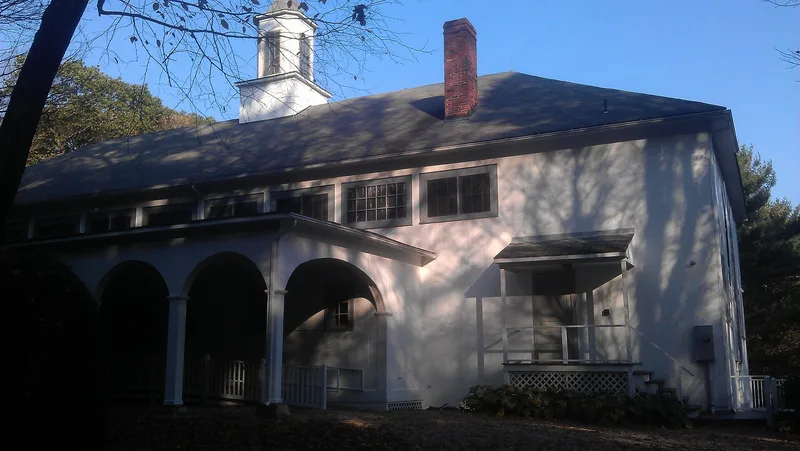
South Mountain Concert Hall is a one-story wooden building near Pittsfield, Massachusetts, placed in the middle of a 200-acre wooded tract that shields performances from outside noise. Measuring 105 by 42 feet, it has a hip roof with a central cupola, five bays of French doors on the east side, and a porte-cochere over the west entrance. Inside, the seats are pews from a de-consecrated Vermont church, and the exposed timbers come from an early nineteenth century mill in Hinsdale. Elizabeth Sprague Coolidge paid for the hall and provided the land, and it opened in September 1918 with the first Berkshire Festival of Chamber Music. Festivals ran through 1925, and about two hundred chamber works have premiered there, including pieces by Bartok, Webern, Ravel, Schoenberg and Stravinsky. Young Audiences Concerts began in 1955, and the surrounding grounds serve as a nature preserve.
Significance in brief: The hall was built with funds and land given by Elizabeth Sprague Coolidge and hosted the first internationally known series of musical events in Berkshire County, the Berkshire Festival of Chamber Music. Some two hundred chamber works have premiered there, and the festival's success led Coolidge to fund the Coolidge Auditorium at the Library of Congress. It has remained a center of music and education for more than half a century.
Machine-generated summary. This summary was generated by a language model from the official nomination document and has not been reviewed line by line by an editor. It may contain errors. Check the source document before relying on any detail. Source: nomination document (PDF) · National Archives catalog entry. NRHP reference 73001943, listed August 14, 1973. Summary generated October 2026 (model claude-sonnet-5-5, prompt v1.0-2026-10-29, confidence medium).
Key facts
| Address | New South Mountain Rd., Pittsfield |
|---|---|
| County | Berkshire County |
| Listed | August 14, 1973 |
| Reference number | 73001943 |
| Resource type | Building |
| Period of significance | 20th Century (specific date 1918) |
| Areas of significance | Education, Performing Arts |
| Level of significance | State |
| Status (as stated in the nomination) | Listed in good condition, unaltered and on its original site; the form marks it as occupied and still used for concerts and educational programs. |
| Acreage | 10 |
| Coordinates | 42.41825, -73.28874 (NPS GIS) |
What listing means for this property
National Register listing is honorary for a privately owned home: it does not by itself restrict what an owner may do with their own money, and it does not require public access. Restrictions come from local landmark or historic-district ordinances, which are separate (how they differ).
Owner-occupied houses are not eligible for the 20% federal rehabilitation tax credit, which applies to income-producing buildings, but many states offer credits for homeowners. Listing also opens the door to preservation easements and to buying a plaque. Start with what listing means for homeowners, renovating a listed house and selling one.
General information, not legal or tax advice. Rules change; confirm with your State Historic Preservation Office or a qualified adviser.
Sources and further reading
- National Park Service, National Register of Historic Places database (snapshot May 2026), reference 73001943.
- Nomination form (PDF, National Archives) — catalog entry
- Wikipedia article (used for cross-checking only; text not reproduced here)
- Wikidata Q7567993
- This listing as JSON
Last updated October 2026. Found an error? See the editorial policy for how to report it.