Old Indian Meeting House
Also known as: Old Indian Church

Why it's listed
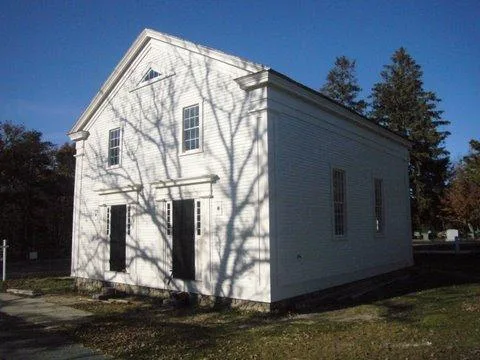
Set on a wooded, triangular 7-acre site near Route 28 on Cape Cod, this wood-frame meeting house has served the Mashpee Wampanoags since the mid-1700s. Oral tradition holds that the building dates to 1684 and was moved to its present site, while written records suggest it may have been built in 1758. The one-and-a-half-story structure has Greek Revival details, likely added in the mid-1850s, and keeps its original pews, post-and-girt framing and a small interior gallery. The grounds hold a burial ground begun in the 1780s and the South Mashpee School, built in 1831 and moved here in 1975. The property is significant as one of the few remaining Indian meeting houses in Massachusetts. Its history reflects the tribe's long effort to govern its own land despite colonial and state guardianship laws, and it was the setting for town meetings until 1888 as well as church gatherings.
Significance in brief: The nomination argues the meeting house is a rare surviving Native American meeting house in Massachusetts. It is tied to the Wampanoag community's struggle for self-government and to the development of the Town of Mashpee. It also has architectural value as a building with Greek Revival details over an earlier frame and interior.
Machine-generated summary. This summary was generated by a language model from the official nomination document and has not been reviewed line by line by an editor. It may contain errors. Check the source document before relying on any detail. Source: nomination document (PDF) · National Archives catalog entry. NRHP reference 98001383, listed December 3, 1998. Summary generated October 2026 (model claude-sonnet-5-5, prompt v1.0-2026-10-29, confidence medium).
Key facts
| Address | 410 Meetinghouse Rd., Mashpee |
|---|---|
| County | Barnstable County |
| Listed | December 3, 1998 |
| Reference number | 98001383 |
| Resource type | Building |
| Period of significance | 1684-1948 |
| Architect / builder | Hinckley, Deacon John |
| Architectural style | Colonial; Greek Revival (also listed: Italianate, Queen Anne, Colonial Revival, Tudor Revival, Craftsman) |
| Criteria |
|
| Areas of significance | Architecture, Education, Native American, Politics/Government, Religion |
| Level of significance | Local |
| Status (as stated in the nomination) | Partly still in religious use and partly a museum; the meeting house and land around it remain owned by the Wampanoag tribe, and the burial ground by the Town of Mashpee. |
| Acreage | 6.8 |
| Coordinates | 41.62439, -70.47860 (NPS GIS) |
What listing means for this property
Religious properties are listed for their architectural or historical significance, not their religious use. Listing is honorary and does not restrict the congregation's use of the building. The federal rehabilitation credit is generally unavailable unless part of the building is income-producing; some state programmes and preservation grants do cover religious buildings. Federal funding or permits trigger Section 106 review.
General information, not legal or tax advice. Rules change; confirm with your State Historic Preservation Office or a qualified adviser.
Sources and further reading
- National Park Service, National Register of Historic Places database (snapshot May 2026), reference 98001383.
- Nomination form (PDF, National Archives) — catalog entry
- Wikipedia article (used for cross-checking only; text not reproduced here)
- Wikidata Q7084268
- This listing as JSON
Last updated October 2026. Found an error? See the editorial policy for how to report it.