Avant House
Also known as: Wanpanoag Indian Museum; Timothy Pocknett Homestead

Why it's listed
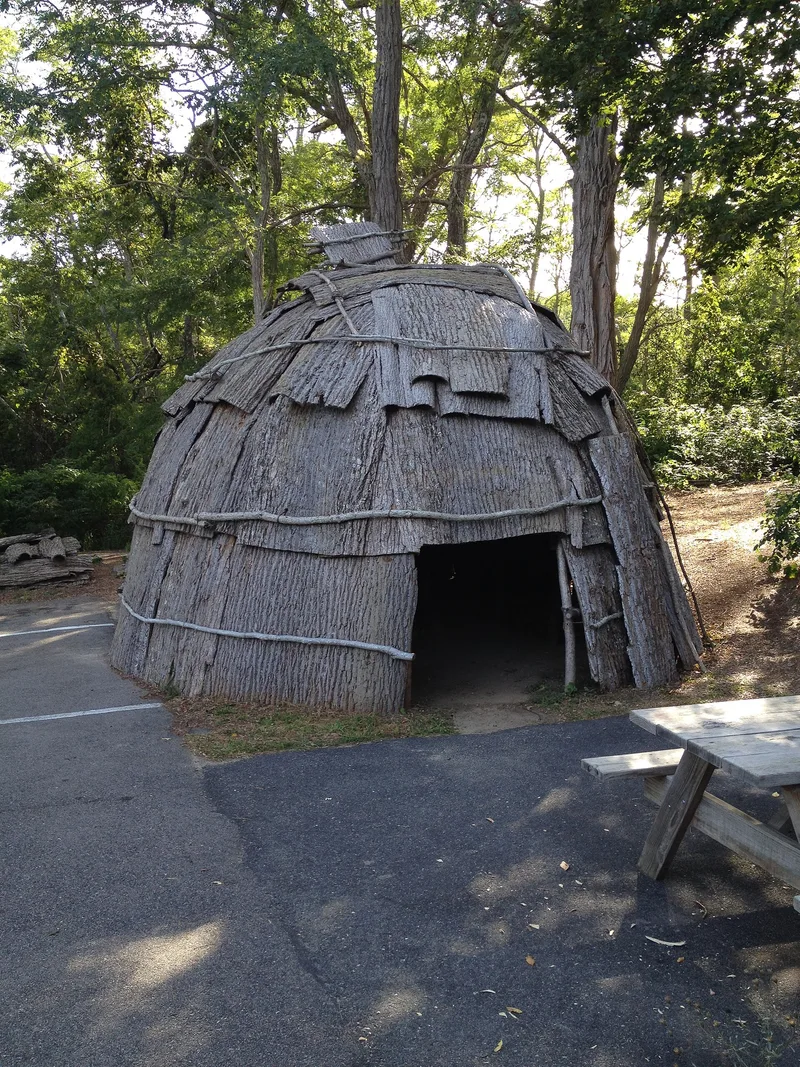
Built around 1830 beside Mill Pond and the Mashpee River, this Half Cape house is a 1 1/2-story, cedar-shingled building measuring 22 by 28 feet, with a one-story side ell. Its detailing is plain, with simple window surrounds, corner boards and 12/12 windows. It is one of the earliest surviving homes in Mashpee, a town where few buildings predate it. Early owners included Captain John Phinney and later Lysander Godfrey, a mariner and cranberry grower. From 1863 to 1888 it was the home of Timothy Pocknet, a Wampanoag who took part in the 1833 call for self-government. George and Mabel Avant later lived here, and Mabel served as Town Clerk and tribal historian. Concern over the loss of Wampanoag history in the 1960s led the town to buy the house in 1970. The Mashpee Wampanoag Indian Museum opened there in 1973, and the building passed to the Tribal Council in 1998. The setting also suggests potential for archaeological remains.
Significance in brief: The nomination argues the house is one of the earliest surviving residences in Mashpee and one of the few early Half Cape houses in the town. Its succession of owners reflects the ethnic groups and trades of the community as it moved from plantation to district to town. It is also tied to Timothy Pocknet, a locally prominent Wampanoag who lived there from 1863 until 1888.
Machine-generated summary. This summary was generated by a language model from the official nomination document and has not been reviewed line by line by an editor. It may contain errors. Check the source document before relying on any detail. Source: nomination document (PDF) · National Archives catalog entry. NRHP reference 98001382, listed December 3, 1998. Summary generated October 2026 (model claude-sonnet-5-5, prompt v1.0-2026-10-29, confidence high).
Key facts
| Address | MA 130 at Mill Pond, Mashpee |
|---|---|
| County | Barnstable County |
| Listed | December 3, 1998 |
| Reference number | 98001382 |
| Resource type | Building |
| Period of significance | c. 1830-1973 |
| Architectural style | Mid 19th Century; Other: Cape Cod (Half Cape) |
| Criteria |
|
| Areas of significance | Architecture, Community Planning and Development, Native American |
| Level of significance | Local |
| Status (as stated in the nomination) | Used as a museum of Mashpee Wampanoag culture; renovated in the early 1970s and transferred from the Town of Mashpee to the Wampanoag Tribal Council in early 1998. |
| Acreage | 0.6 |
| Coordinates | 41.64928, -70.48612 (NPS GIS) |
What listing means for this property
National Register listing is honorary for a privately owned home: it does not by itself restrict what an owner may do with their own money, and it does not require public access. Restrictions come from local landmark or historic-district ordinances, which are separate (how they differ).
Owner-occupied houses are not eligible for the 20% federal rehabilitation tax credit, which applies to income-producing buildings, but many states offer credits for homeowners. Listing also opens the door to preservation easements and to buying a plaque. Start with what listing means for homeowners, renovating a listed house and selling one.
General information, not legal or tax advice. Rules change; confirm with your State Historic Preservation Office or a qualified adviser.
Sources and further reading
- National Park Service, National Register of Historic Places database (snapshot May 2026), reference 98001382.
- Nomination form (PDF, National Archives) — catalog entry
- Wikipedia article (used for cross-checking only; text not reproduced here)
- Wikidata Q4827677
- This listing as JSON
Last updated October 2026. Found an error? See the editorial policy for how to report it.