Jenkins, John, Homestead
Also known as: Old Parsonage; Jenkins,Elizabeth C.,House; Shaw,Lemuel,House

Why it's listed
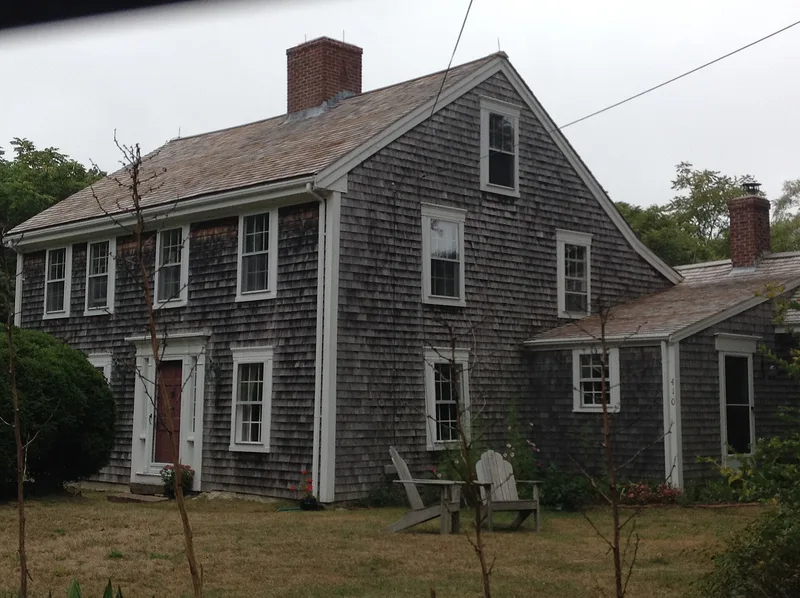
This house on Church Street in West Barnstable began as a farm dwelling built before 1683 by John Jenkins, who arrived in the village in 1652 and developed the land for farming and livestock. Over three centuries it was altered, with changes recorded in 1780, 1855, 1921 and 1968, and it now shows late Georgian or early Federal character: a shallow gable roof, an off-center chimney aligned with the front door, and six-over-six windows. A fireplace brick is inscribed 1685. It became known as The Old Parsonage through Pastor Oakes Shaw, who owned it from 1763 to 1807 and served West Parish Church for 47 years. His son Lemuel Shaw was born here and became Chief Justice of the Massachusetts Supreme Judicial Court. In 1914 Elizabeth Crocker Jenkins bought the neglected property, restored it, led restoration of the West Parish Church, and deeded a wildlife reservation to the town.
Significance in brief: The nomination argues the house is tied to West Barnstable's development and to several notable residents: John Jenkins, Pastor Oakes Shaw, Chief Justice Lemuel Shaw and Elizabeth Crocker Jenkins. It is also important as a 17th century dwelling expanded and altered over time to reflect its residents' tastes. It is argued to meet criteria A, B and C.
Machine-generated summary. This summary was generated by a language model from the official nomination document and has not been reviewed line by line by an editor. It may contain errors. Check the source document before relying on any detail. Source: nomination document (PDF) · National Archives catalog entry. NRHP reference 87000318, listed March 13, 1987. Summary generated October 2026 (model claude-sonnet-5-5, prompt v1.0-2026-10-29, confidence high).
Key facts
| Address | Church St., Barnstable |
|---|---|
| County | Barnstable County |
| Listed | March 13, 1987 |
| Reference number | 87000318 |
| Resource type | Building |
| Architectural style | Colonial (Cape three quarter house, two and a half story, modified); present style described as late Georgian or early Federal |
| Criteria |
|
| Areas of significance | Agriculture, Architecture, Social History |
| Level of significance | Local |
| Status (as stated in the nomination) | Recorded in excellent condition and in use as a residence, with an attached garage. |
| Acreage | 2.8 |
| Coordinates | 41.69487, -70.36941 (NPS GIS) |
What listing means for this property
National Register listing is honorary for a privately owned home: it does not by itself restrict what an owner may do with their own money, and it does not require public access. Restrictions come from local landmark or historic-district ordinances, which are separate (how they differ).
Owner-occupied houses are not eligible for the 20% federal rehabilitation tax credit, which applies to income-producing buildings, but many states offer credits for homeowners. Listing also opens the door to preservation easements and to buying a plaque. Start with what listing means for homeowners, renovating a listed house and selling one.
General information, not legal or tax advice. Rules change; confirm with your State Historic Preservation Office or a qualified adviser.
Sources and further reading
- National Park Service, National Register of Historic Places database (snapshot May 2026), reference 87000318.
- Nomination form (PDF, National Archives) — catalog entry
- Wikipedia article (used for cross-checking only; text not reproduced here)
- Wikidata Q6241792
- This listing as JSON
Last updated October 2026. Found an error? See the editorial policy for how to report it.