Brandeis, Louis, House

Why it's listed
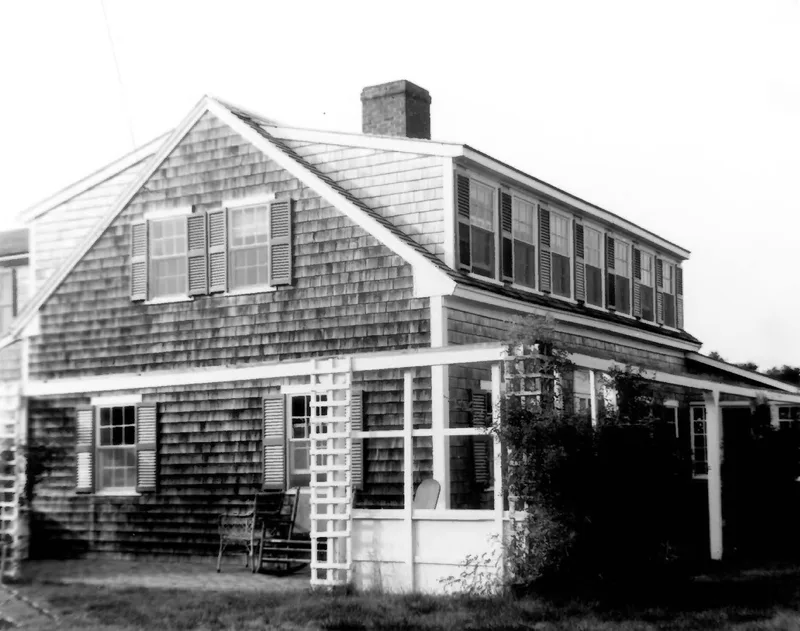
Set at the end of a sandy road near the Oyster River, southwest of Chatham, this shingled Cape Cod house was the summer home of Supreme Court Justice Louis Brandeis. The main block, apparently built in the early 19th century, has a symmetrical five-bay facade, a steep roof, a central chimney and six-over-six windows with blue louvered blinds. A tall hedge planted in Brandeis's lifetime screens it from the approach. Later additions include shed dormers, a rear kitchen wing and a rear outbuilding with guest rooms. Brandeis and his wife first visited Chatham in 1922 and bought the property the next year, returning each summer for the rest of their lives. He kept working on legal cases there while living plainly, and visitors came to seek his advice. Brandeis was a Progressive reformer and a Supreme Court Justice whose dissents later shaped American law. The house has seen little change, and his descendants still use it.
Significance in brief: The house is associated with Louis Brandeis, a Progressive reformer and Supreme Court Justice known for defending individual dignity and the right to dissent. He and his wife summered here from 1923 until his death in 1941, working on legal cases while living simply. The house and its setting remain little changed.
Machine-generated summary. This summary was generated by a language model from the official nomination document and has not been reviewed line by line by an editor. It may contain errors. Check the source document before relying on any detail. Source: nomination document (PDF) · National Archives catalog entry. NRHP reference 72000148, listed November 28, 1972. Summary generated October 2026 (model claude-sonnet-5-5, prompt v1.0-2026-10-29, confidence medium).
Key facts
| Address | Neck Lane, off Cedar St., 8 mi. SW of Stage Harbor Rd. intersection, Chatham |
|---|---|
| County | Barnstable County |
| Listed | November 28, 1972 |
| Reference number | 72000148 |
| Resource type | Building |
| Period of significance | 1922 - 1941 |
| Architectural style | Vernacular Cape Cod architecture |
| Areas of significance | Law, Social History |
| Level of significance | National |
| National Historic Landmark | Yes, designated May 15, 1975 |
| Status (as stated in the nomination) | Condition listed as good, occupied, and used as a private residence by Brandeis's descendants; the house has had only minimal structural change. |
| Acreage | 8 |
| Coordinates | 41.67329, -69.98356 (NPS GIS) |
What listing means for this property
National Register listing is honorary for a privately owned home: it does not by itself restrict what an owner may do with their own money, and it does not require public access. Restrictions come from local landmark or historic-district ordinances, which are separate (how they differ).
Owner-occupied houses are not eligible for the 20% federal rehabilitation tax credit, which applies to income-producing buildings, but many states offer credits for homeowners. Listing also opens the door to preservation easements and to buying a plaque. Start with what listing means for homeowners, renovating a listed house and selling one.
General information, not legal or tax advice. Rules change; confirm with your State Historic Preservation Office or a qualified adviser.
Sources and further reading
- National Park Service, National Register of Historic Places database (snapshot May 2026), reference 72000148.
- Nomination form (PDF, National Archives) — catalog entry
- Wikipedia article (used for cross-checking only; text not reproduced here)
- Wikidata Q6686787
- This listing as JSON
Last updated October 2026. Found an error? See the editorial policy for how to report it.