Flanagan, Judge, Residence

Why it's listed
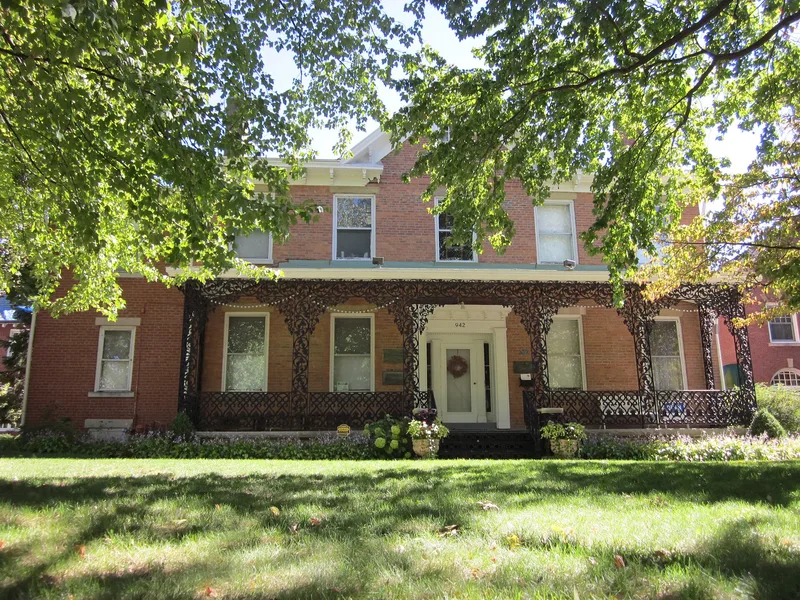
Built in 1837 for Judge John C. Flanagan, this brick house at 942 N.E. Glen Oak Avenue sits on Peoria's East Bluff, above the Illinois River. Flanagan, born in Philadelphia in 1806, came to Peoria in 1831 and bought 20 acres of the bluff. Bricks for the 15-inch walls were made on site, walnut from the property was sawn for the floor joists, and lumber, lime and glass came from Chicago. The house has classical entrances on both north and south, so it effectively has two fronts, and its porches carry ornate wrought iron in a grapevine pattern. The kitchen was moved upstairs from the English basement and a wing was added about 50 years after construction. It went up only 18 years after the first white settlement in Peoria. Local tradition holds that Abraham Lincoln stayed here during the debates and campaigns of 1854-1860. It now serves as a museum with exhibit space in the basement.
Significance in brief: The nomination cites the house for its architecture, a post-Colonial design with classical entrances on both north and south sides. It also stresses its early date, built 18 years after Peoria's first white settlement, and its solid brick construction using locally made materials. Local tradition links it to Abraham Lincoln as a guest during the 1854-1860 debates and campaigns.
Machine-generated summary. This summary was generated by a language model from the official nomination document and has not been reviewed line by line by an editor. It may contain errors. Check the source document before relying on any detail. Source: nomination document (PDF) · National Archives catalog entry. NRHP reference 75000670, listed September 5, 1975. Summary generated October 2026 (model claude-sonnet-5-5, prompt v1.0-2026-10-29, confidence medium).
Key facts
| Address | 942 NE Glen Oak Ave., Peoria |
|---|---|
| County | Peoria County |
| Listed | September 5, 1975 |
| Reference number | 75000670 |
| Resource type | Building |
| Period of significance | 1837 |
| Architect / builder | Built by Judge John C. Flanagan |
| Architectural style | Post-Colonial (a later data sheet notes Italianate and Federal elements) |
| Areas of significance | Architecture |
| Level of significance | State |
| Status (as stated in the nomination) | Owned by the Peoria Historical Society and used as a museum; the form lists condition as good and the property as occupied, with some work in progress. |
| Acreage | 0.9 |
| Coordinates | 40.70401, -89.58546 (NPS GIS) |
What listing means for this property
National Register listing is honorary for a privately owned home: it does not by itself restrict what an owner may do with their own money, and it does not require public access. Restrictions come from local landmark or historic-district ordinances, which are separate (how they differ).
Owner-occupied houses are not eligible for the 20% federal rehabilitation tax credit, which applies to income-producing buildings, but many states offer credits for homeowners. Listing also opens the door to preservation easements and to buying a plaque. Start with what listing means for homeowners, renovating a listed house and selling one.
General information, not legal or tax advice. Rules change; confirm with your State Historic Preservation Office or a qualified adviser.
Sources and further reading
- National Park Service, National Register of Historic Places database (snapshot May 2026), reference 75000670.
- Nomination form (PDF, National Archives) — catalog entry
- Wikipedia article (used for cross-checking only; text not reproduced here)
- Wikidata Q6224409
- This listing as JSON
Last updated October 2026. Found an error? See the editorial policy for how to report it.