Indian Statue
Also known as: "Black Hawk" Statue

Why it's listed
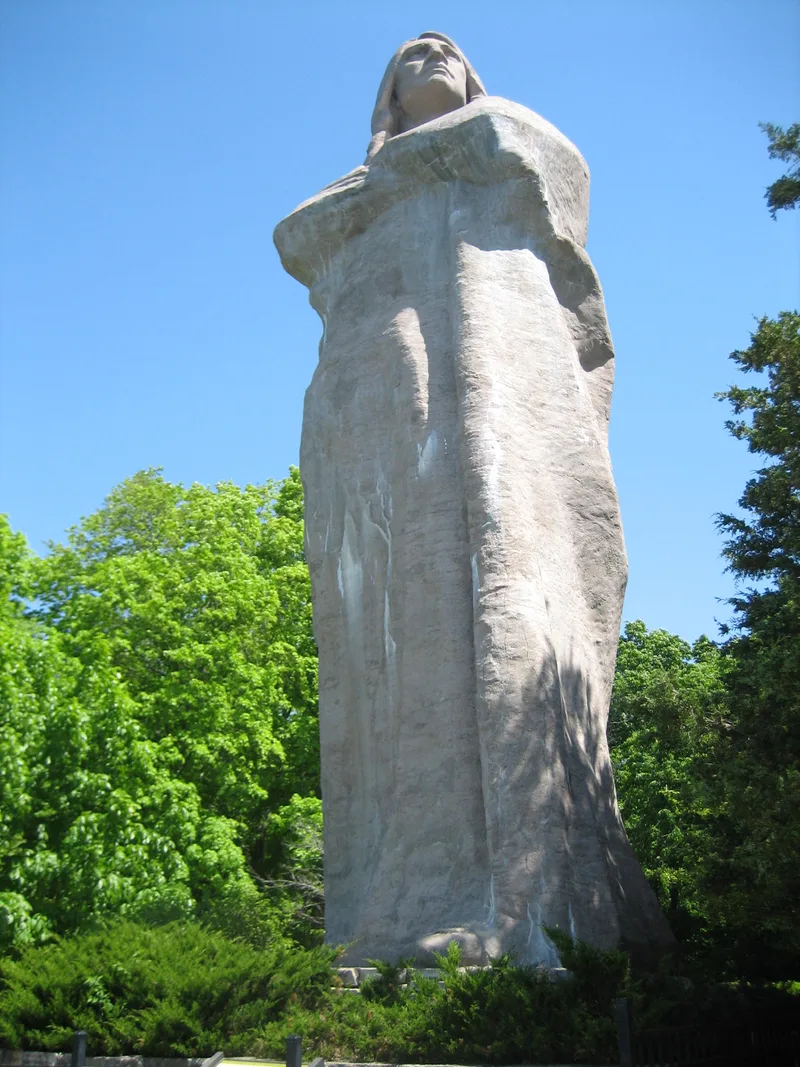
Rising 48 feet 4 inches above the Rock River bluff in Lowden Memorial State Park near Oregon, Illinois, this figure of an American Indian stands with folded arms wrapped in a blanket, gazing southwest over the valley. Sculptor Lorado Taft designed it, and John Prasuhn supervised construction. Workers poured the reinforced concrete continuously for ten days in freezing December 1910, with an outer layer of pink granite chips. The statue is widely called "Black Hawk," but Taft never gave it that name and intended it to represent a general Indian personality drawn from several peoples. It was listed for its artistic value: it was the largest monolithic poured concrete statue in the country, it showed a new use for cement in art, and it is the work of a nationally known master. Repeated repairs since 1945 have left cracks and patches, yet the design and detail remain clear, and the wooded bluff setting retains high integrity.
Significance in brief: The nomination argues the statue is nationally significant under Criterion C in the area of art. At the time it was the largest monolithic poured concrete statue in the United States and showed a new artistic use for modern cement. It is also the work of master sculptor Lorado Taft, and it drew international attention as an important piece of public sculpture.
Machine-generated summary. This summary was generated by a language model from the official nomination document and has not been reviewed line by line by an editor. It may contain errors. Check the source document before relying on any detail. Source: nomination document (PDF) · National Archives catalog entry. NRHP reference 09000871, listed November 5, 2009. Summary generated October 2026 (model claude-sonnet-5-5, prompt v1.0-2026-10-29, confidence high).
Key facts
| Address | Lowden Memorial State Park, 1411 N. River Rd., Oregon |
|---|---|
| County | Ogle County |
| Listed | November 5, 2009 |
| Reference number | 09000871 |
| Resource type | Object |
| Period of significance | 1911 |
| Architect / builder | Taft, Lorado Z. |
| Architectural style | NA: work of art |
| Criteria |
|
| Areas of significance | Art |
| Level of significance | National |
| Status (as stated in the nomination) | Described as in remarkably stable condition overall, though the folded-arms area shows spalling, delamination and many generations of patch repairs. It is a publicly owned object in a state park. |
| Acreage | 0.9 |
| Coordinates | 42.03609, -89.33319 (NPS GIS) |
What listing means for this property
National Register listing is honorary: it recognises significance and does not restrict what a private owner may do without federal money or permits. It unlocks the 20% federal rehabilitation tax credit for income-producing buildings, state credits in many states, and Section 106 review when federal agencies are involved. See what listing means in practice.
General information, not legal or tax advice. Rules change; confirm with your State Historic Preservation Office or a qualified adviser.
Sources and further reading
- National Park Service, National Register of Historic Places database (snapshot May 2026), reference 09000871.
- Nomination form (PDF, National Archives) — catalog entry
- Wikipedia article (used for cross-checking only; text not reproduced here)
- Wikidata Q4920889
- This listing as JSON
Last updated October 2026. Found an error? See the editorial policy for how to report it.