Ravinia Park Historic District

Why it's listed
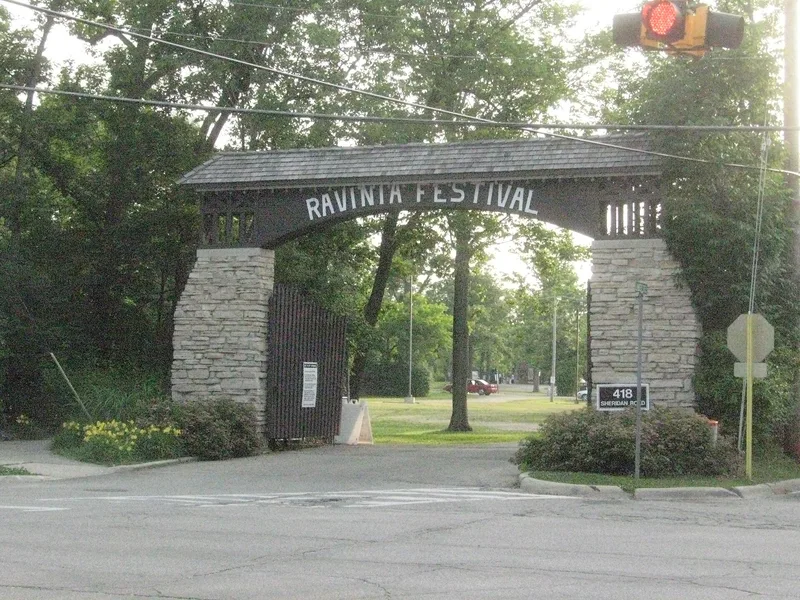
Ravinia Park occupies about 36 acres in Highland Park, Illinois, and serves as the summer home of the Chicago Symphony Orchestra. It began in 1902 when the Chicago and Milwaukee Electric Railroad bought wooded land to create a resort that would attract railroad riders. Architect Peter Weber designed four buildings, and the park opened in August 1904 as an amusement park. Two of those buildings survive: the Casino and the theatre, later renamed the Murray Theatre. Both are stucco with towers, red tile roofs, stained glass and Arts and Crafts woodwork. Wooden entrance gates with broad elliptical arches also remain. After the railway entered receivership in 1908, opera became the main attraction, and the years 1918-1931 were known as the Golden Age of Opera at Ravinia. The park closed during the Depression and reopened in 1936 as the Ravinia Festival. A 1950 concrete pavilion replaced a wooden one lost to fire, and the grounds remain in active concert use.
Significance in brief: The district preserves two surviving 1904 buildings by architect Peter Weber, the Murray Theatre and the Casino, along with original wooden gates, all with Arts and Crafts detailing. It is also significant as a long-running center for classical music and opera, from the Golden Age of Opera in 1918-1931 to the Ravinia Festival after 1936.
Machine-generated summary. This summary was generated by a language model from the official nomination document and has not been reviewed line by line by an editor. It may contain errors. Check the source document before relying on any detail. Source: nomination document (PDF) · National Archives catalog entry. NRHP reference 82002575, listed September 29, 1982. Summary generated October 2026 (model claude-sonnet-5-5, prompt v1.0-2026-10-29, confidence medium).
Key facts
| Address | Roughly bounded by Lambert Tree Ave., Sheridan Rd., St. Johns Ave., Rambler Lane, and Ravinia Park Ave., Highland Park |
|---|---|
| County | Lake County |
| Listed | September 29, 1982 |
| Reference number | 82002575 |
| Resource type | District |
| Architect / builder | Peter Weber (architect of the original buildings); Holabird and Root (later pavilion and restaurant work) |
| Architectural style | Spanish-derived forms with Arts and Crafts detailing |
| Areas of significance | Architecture |
| Level of significance | State |
| Status (as stated in the nomination) | Actively used each concert season; the Murray Theatre was renovated in 1976 and the Casino partially renovated in 1956. |
| Acreage | 36 |
| Coordinates | 42.15987, -87.77404 (NPS GIS) |
What listing means for this property
This is a historic district. Buildings within its boundary are either contributing (they add to the district's significance) or non-contributing. Owners of contributing income-producing buildings can claim the 20% federal rehabilitation tax credit; homeowners should look at state credits. National Register districts impose no design review by themselves; a local historic district ordinance, if one exists, does (the difference explained).
General information, not legal or tax advice. Rules change; confirm with your State Historic Preservation Office or a qualified adviser.
Sources and further reading
- National Park Service, National Register of Historic Places database (snapshot May 2026), reference 82002575.
- Nomination form (PDF, National Archives) — catalog entry
- Wikipedia article (used for cross-checking only; text not reproduced here)
- Wikidata Q133502844
- This listing as JSON
Last updated October 2026. Found an error? See the editorial policy for how to report it.