Wooden Alley
Also known as: Alley between Astor and State Streets

Why it's listed
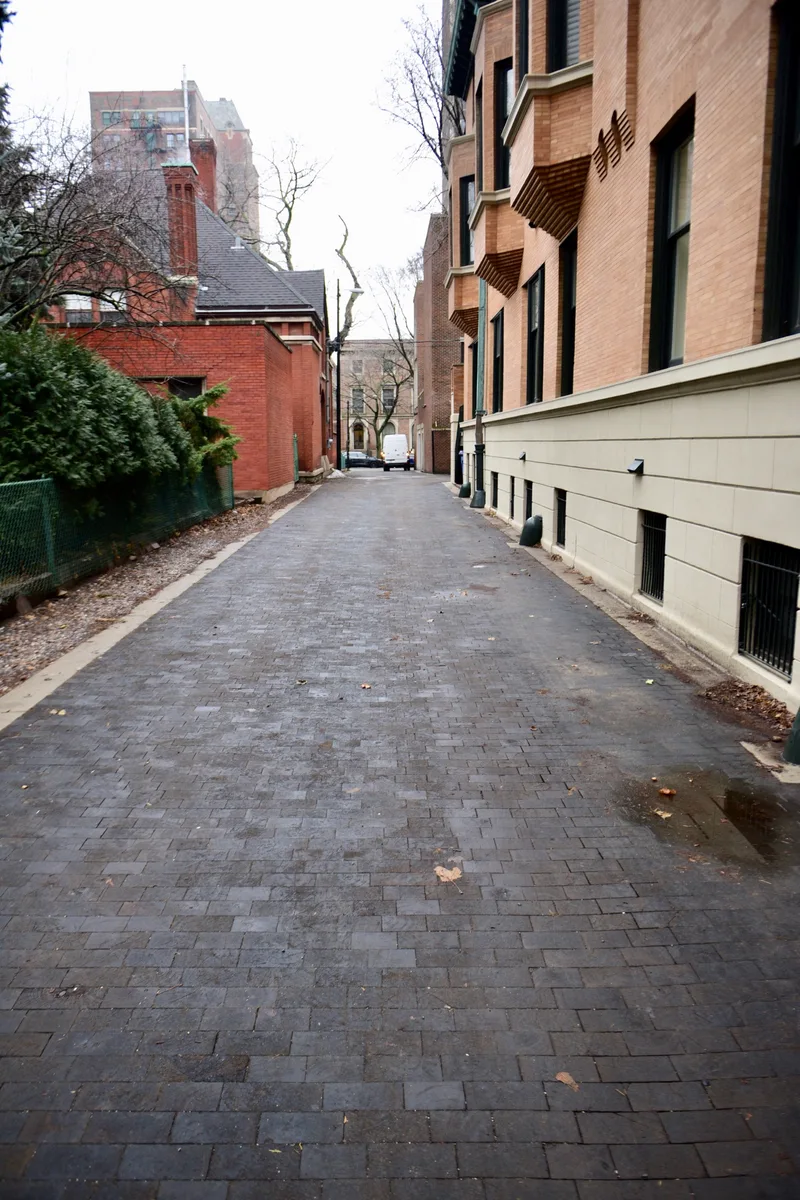
This 530-foot alley between Astor and State Streets in Chicago's Gold Coast is paved with creosote-treated cedar blocks laid in 1909. The blocks are four inches thick and wide, set in parallel lines across the 18-foot width, with asphalt at each end and a few asphalt patches. Alexander Todd was the paving subcontractor, and the work cost $3,343.96. It was built when wood paving was nearly obsolete; only eight alleys paved that year used it. Wooden block paving was once Chicago's main street surface, favored because the city's huge lumber market made wood cheap. Changes in lumber supply and in how property owners could pay assessments led the city to move to other materials. Only one other wooden alley is known in the city, a roughly 100-foot stretch on Hudson Street in much poorer shape. The alley's good condition and its setting among homes built from 1880 to 1916 make it the best surviving example of this paving type.
Significance in brief: The alley is argued to be significant under Criterion C as a rare surviving example of wooden block paving, once Chicago's predominant street paving method. Only two wooden alleys are known to survive in the city, and this one is far better preserved. It illustrates the engineering, public works and lumber-market history behind Chicago's growth.
Machine-generated summary. This summary was generated by a language model from the official nomination document and has not been reviewed line by line by an editor. It may contain errors. Check the source document before relying on any detail. Source: nomination document (PDF) · National Archives catalog entry. NRHP reference 02000543, listed May 22, 2002. Summary generated October 2026 (model claude-sonnet-5-5, prompt v1.0-2026-10-29, confidence high).
Key facts
| Address | 1535 N bet. Astor and State Sts., Chicago |
|---|---|
| County | Cook County |
| Listed | May 22, 2002 |
| Reference number | 02000543 |
| Resource type | Structure |
| Period of significance | 1909 |
| Architect / builder | Todd, Alexander, subcontractor |
| Architectural style | Other: Wooden Block Paving; Nicholsonesque Paving |
| Criteria |
|
| Areas of significance | Engineering |
| Level of significance | Local |
| Status (as stated in the nomination) | Described as in good to exemplary condition, with some asphalt patches and a few small areas of poor repair; still in road-related use. |
| Acreage | 0.9 |
| Within district | Lincoln Park |
| Coordinates | 41.91282, -87.62827 (NPS GIS) |
What listing means for this property
National Register listing is honorary: it recognises significance and does not restrict what a private owner may do without federal money or permits. It unlocks the 20% federal rehabilitation tax credit for income-producing buildings, state credits in many states, and Section 106 review when federal agencies are involved. See what listing means in practice.
General information, not legal or tax advice. Rules change; confirm with your State Historic Preservation Office or a qualified adviser.
Sources and further reading
- National Park Service, National Register of Historic Places database (snapshot May 2026), reference 02000543.
- Nomination form (PDF, National Archives) — catalog entry
- Wikipedia article (used for cross-checking only; text not reproduced here)
- Wikidata Q48848411
- This listing as JSON
Last updated October 2026. Found an error? See the editorial policy for how to report it.