West Burton Place Historic District

Why it's listed
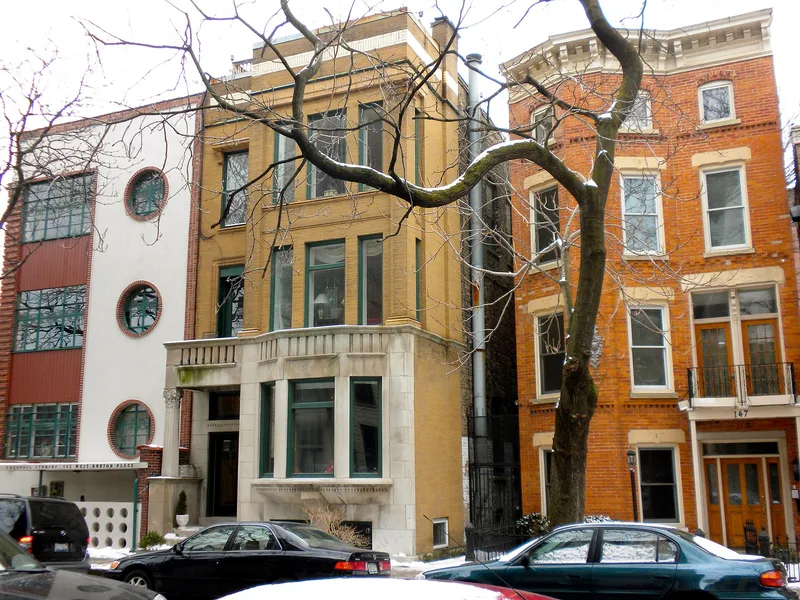
West Burton Place is a single short block in Chicago's Old Town neighborhood, with twelve principal buildings and five residential coach houses. Most were built between 1877 and 1896 as dwellings and three-flat buildings in Italianate, Queen Anne or Classical Revival forms. Five of these still look much as they did in the nineteenth century. Seven were remodeled between 1924 and 1940 into artists' studios, with Art Deco, Art Moderne or International Style features. The best-known project is the Carl Street Studios at 155 W. Burton Place, led by artist Sol Kogen and designer Edgar Miller. It uses stone, ceramic tile, carved wood and salvaged materials throughout. Craftsmen such as Jesus Torres contributed carved doors, staircases and copper trim. The block is significant as a Depression-era effort to rework aging urban housing through handcrafted design. That effort influenced Old Town's reputation for the arts and early rehabilitation of city dwellings. Both the nineteenth-century and 1930s buildings retain good integrity.
Significance in brief: The district is significant architecturally and artistically because artists and craftspeople in the Depression era turned deteriorating nineteenth-century rooming houses into distinctive studio dwellings. Sol Kogen and Edgar Miller led this work, beginning with the Carl Street Studios. The street became a center of artistic innovation and a forerunner of Chicago's back-to-the-city rehabilitation movement.
Machine-generated summary. This summary was generated by a language model from the official nomination document and has not been reviewed line by line by an editor. It may contain errors. Check the source document before relying on any detail. Source: nomination document (PDF) · National Archives catalog entry. NRHP reference 07001239, listed December 6, 2007. Summary generated October 2026 (model claude-sonnet-5-5, prompt v1.0-2026-10-29, confidence high).
Key facts
| Address | 143-161 W Burton Pl, Chicago |
|---|---|
| County | Cook County |
| Listed | December 6, 2007 |
| Reference number | 07001239 |
| Resource type | District |
| Period of significance | 1880-1940 |
| Architect / builder | Edgar Miller |
| Architectural style | Moderne |
| Criteria |
|
| Areas of significance | Architecture, Art |
| Level of significance | Local |
| Status (as stated in the nomination) | All twelve principal buildings and five coach houses remain in residential use, as condominiums, apartments, a cooperative and a single-family house. |
| Acreage | 3 |
| Coordinates | 41.90933, -87.63388 (NPS GIS) |
What listing means for this property
This is a historic district. Buildings within its boundary are either contributing (they add to the district's significance) or non-contributing. Owners of contributing income-producing buildings can claim the 20% federal rehabilitation tax credit; homeowners should look at state credits. National Register districts impose no design review by themselves; a local historic district ordinance, if one exists, does (the difference explained).
General information, not legal or tax advice. Rules change; confirm with your State Historic Preservation Office or a qualified adviser.
Sources and further reading
- National Park Service, National Register of Historic Places database (snapshot May 2026), reference 07001239.
- Nomination form (PDF, National Archives) — catalog entry
- Wikipedia article (used for cross-checking only; text not reproduced here)
- Wikidata Q48815475
- This listing as JSON
Last updated October 2026. Found an error? See the editorial policy for how to report it.