Schorsch Irving Park Gardens Historic District
Also known as: Portage Park Historic District

Why it's listed
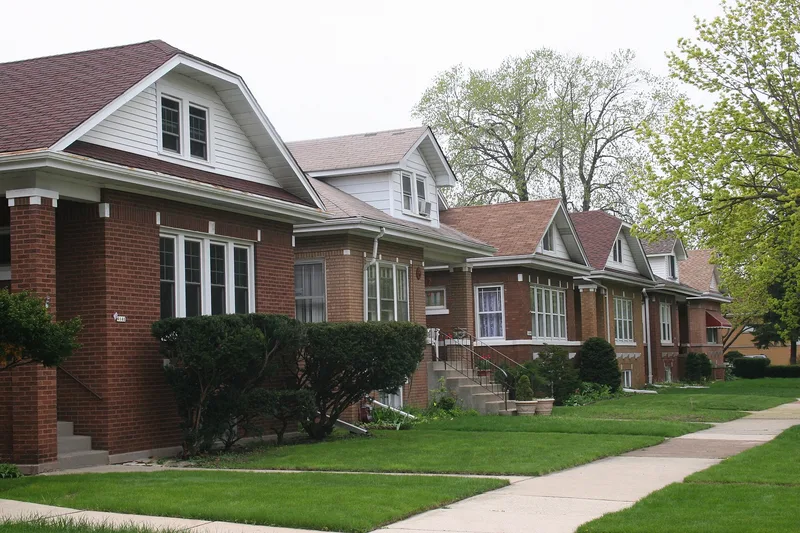
Eight blocks of the northwest side of Chicago, about nine miles from the commercial center, make up a neighborhood of brick bungalows built mainly by one contractor, Albert J. Schorsch. After O.A. Thorp Elementary School opened in 1916, he developed nearly all of the area between 1917 and 1926, in two building campaigns. The district holds 252 bungalows, a two-flat, a store-and-residence building and the school. Houses sit on uniform lots with similar setbacks, low-pitched roofs, overhanging eaves and ribbon windows, while limestone trim, varied brickwork, roof shapes and porch arrangements give each home some individuality. Architects named for the houses include Ernest N. Braucher and Axel V. Teisen. The area is significant for its link to the promotion of single-family homeownership in Chicago, and as a well-preserved example of the Chicago bungalow. Only six buildings have been altered enough to lose contributing status, and the neighborhood remains entirely residential.
Significance in brief: The district is significant under Criterion A for its association with the promotion of single-family homeownership in Chicago, as an alternative to the growing density of apartments and tenements. It is significant under Criterion C as a cohesive collection of Chicago bungalows built in two main campaigns, 1917-1918 and 1922-1926. Its uniform siting and materials, combined with variation in rooflines, massing and ornament, show the bungalow type at neighborhood scale.
Machine-generated summary. This summary was generated by a language model from the official nomination document and has not been reviewed line by line by an editor. It may contain errors. Check the source document before relying on any detail. Source: nomination document (PDF) · National Archives catalog entry. NRHP reference 04000075, listed February 25, 2004. Summary generated October 2026 (model claude-sonnet-5-5, prompt v1.0-2026-10-29, confidence high).
Key facts
| Address | Roughly bounded by Grace St., Patterson Ave., N. Austin Ave., and N. Melvena Ave., Chicago |
|---|---|
| County | Cook County |
| Listed | February 25, 2004 |
| Reference number | 04000075 |
| Resource type | District |
| Period of significance | 1917-1930 |
| Architect / builder | Braucher, Ernest N., architect; Schorsch, Albert J., developer |
| Architectural style | Other: Chicago Bungalow |
| Criteria |
|
| Areas of significance | Community Planning and Development, Architecture |
| Level of significance | Local |
| Status (as stated in the nomination) | Still entirely residential; most bungalows retain their early twentieth-century appearance, and only six have been altered enough to be non-contributing. |
| Acreage | 27 |
| Coordinates | 41.95007, -87.77918 (NPS GIS) |
What listing means for this property
This is a historic district. Buildings within its boundary are either contributing (they add to the district's significance) or non-contributing. Owners of contributing income-producing buildings can claim the 20% federal rehabilitation tax credit; homeowners should look at state credits. National Register districts impose no design review by themselves; a local historic district ordinance, if one exists, does (the difference explained).
General information, not legal or tax advice. Rules change; confirm with your State Historic Preservation Office or a qualified adviser.
Sources and further reading
- National Park Service, National Register of Historic Places database (snapshot May 2026), reference 04000075.
- Nomination form (PDF, National Archives) — catalog entry
- Wikipedia article (used for cross-checking only; text not reproduced here)
- Wikidata Q85799957
- This listing as JSON
Last updated October 2026. Found an error? See the editorial policy for how to report it.