Lloyd, Henry Demarest, House
Also known as: Wayside,The

Why it's listed
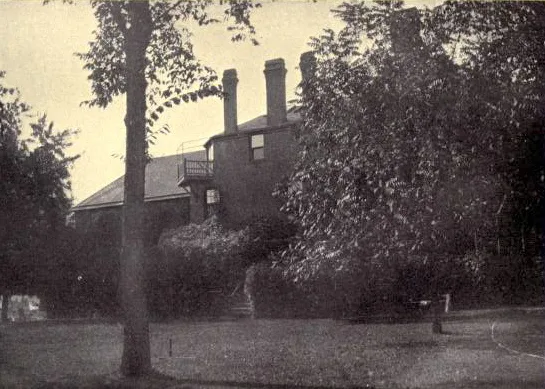
The Wayside, at 830 Sheridan Road in Winnetka, Illinois, is a two-and-one-half story red brick house with white trim and a blue shingled roof. It faces Lake Michigan across Lloyd Park, once part of the property. A wraparound wooden porch, a porte cochere, and board-and-batten outbuildings, including a barn with a children's gymnasium from about 1896, complete the grounds. The Lloyd family restored the house in 1878 from a deserted inn. It was the home of Henry Demarest Lloyd, a journalist and reformer who criticized industrial monopolies and trusts. His 1894 book, Wealth Against Commonwealth, became a landmark in antimonopoly writing. He also backed labor unions and worked to commute death sentences after the Haymarket affair. Visitors included Governor John P. Altgeld, Booker T. Washington, and Jane Addams, who called the house an annex to Hull House. Lloyd's third-floor study, added in 1886, remains virtually unchanged, with his desk and books.
Significance in brief: The house was the home of Henry Demarest Lloyd, a leading critic of industrial monopoly and trusts in the late 1800s. He wrote Wealth Against Commonwealth (1894), supported labor causes, and defended those accused in the Haymarket affair. The Wayside also hosted many reformers and public figures, and Lloyd's third-floor study survives virtually unchanged.
Machine-generated summary. This summary was generated by a language model from the official nomination document and has not been reviewed line by line by an editor. It may contain errors. Check the source document before relying on any detail. Source: nomination document (PDF) · National Archives catalog entry. NRHP reference 66000320, listed November 13, 1966. Summary generated October 2026 (model claude-sonnet-5-5, prompt v1.0-2026-10-29, confidence medium).
Key facts
| Address | 830 Sheridan Rd., Winnetka |
|---|---|
| County | Cook County |
| Listed | November 13, 1966 |
| Reference number | 66000320 |
| Resource type | Building |
| Period of significance | 1878-1903 |
| Architect / builder | Unknown |
| Areas of significance | Politics/Government, Social History |
| Level of significance | National |
| National Historic Landmark | Yes, designated November 13, 1966 |
| Status (as stated in the nomination) | Occupied as a private residence; described as little changed since about 1900, with the original site retained. Boundary reduced after 1977 subdivision. |
| Acreage | 1.5 |
| Coordinates | 42.11419, -87.73229 (NPS GIS) |
What listing means for this property
National Register listing is honorary for a privately owned home: it does not by itself restrict what an owner may do with their own money, and it does not require public access. Restrictions come from local landmark or historic-district ordinances, which are separate (how they differ).
Owner-occupied houses are not eligible for the 20% federal rehabilitation tax credit, which applies to income-producing buildings, but many states offer credits for homeowners. Listing also opens the door to preservation easements and to buying a plaque. Start with what listing means for homeowners, renovating a listed house and selling one.
General information, not legal or tax advice. Rules change; confirm with your State Historic Preservation Office or a qualified adviser.
Sources and further reading
- National Park Service, National Register of Historic Places database (snapshot May 2026), reference 66000320.
- Nomination form (PDF, National Archives) — catalog entry
- Wikipedia article (used for cross-checking only; text not reproduced here)
- Wikidata Q7773967
- This listing as JSON
Last updated October 2026. Found an error? See the editorial policy for how to report it.