Hyde Park-Kenwood Historic District
Also known as: See Also:Hyde Park-Kenwood Historic District (Boundary Incre

Why it's listed
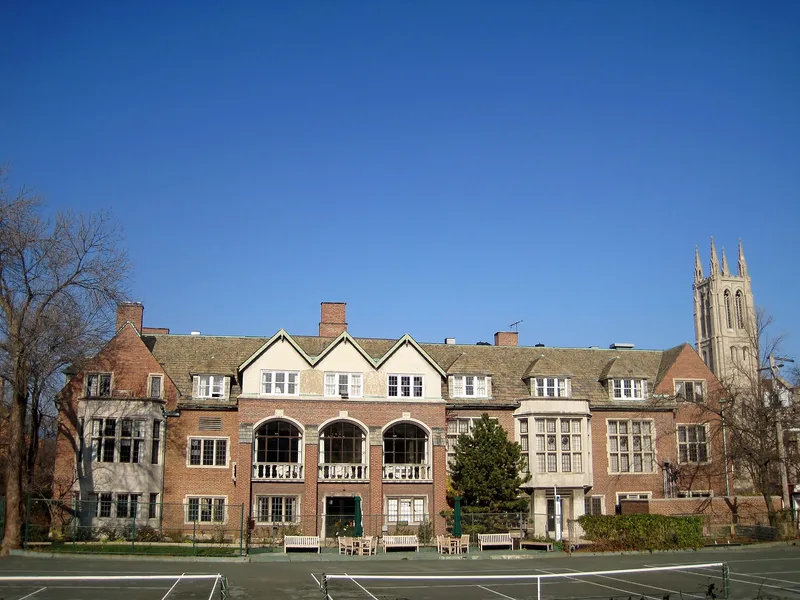
Hyde Park and Kenwood form a dense residential area about six miles south of downtown Chicago, just west of Lake Michigan. The district spans most of both traditional neighborhoods, from 47th Street south to the Midway Plaisance, and holds roughly 1,650 structures. Houses, two-family buildings, attached residences and low-rise apartments share a surprisingly uniform scale, mostly two to four stories. The nomination stresses that the overall quality of this fabric, rather than only its landmark buildings, justifies the district, though 461 structures were singled out for special merit. Styles run from a few early Italianate houses through Queen Anne, Gothic, Tudor and classical revivals, alongside notable Prairie School work including buildings by Frank Lloyd Wright. Many well-known architects worked here between about 1890 and 1920. The district also housed prominent professors, writers, educators and public figures, and it includes University of Chicago buildings. Postwar redevelopment removed some older fabric, but most new construction was judged compatible.
Significance in brief: The nomination argues the district's significance rests on the unusually high quality and unity of its building stock as a whole, with about 461 of roughly 1,650 structures evaluated as architecturally or historically significant. It contains work by many notable architects, including Frank Lloyd Wright, and was home to prominent educators, authors and public figures. Styles range from Italianate and Queen Anne to Gothic, Classical revivals and the Prairie School.
Machine-generated summary. This summary was generated by a language model from the official nomination document and has not been reviewed line by line by an editor. It may contain errors. Check the source document before relying on any detail. Source: nomination document (PDF) · National Archives catalog entry. NRHP reference 79000824, listed February 14, 1979. Summary generated October 2026 (model claude-sonnet-5-5, prompt v1.0-2026-10-29, confidence medium).
Key facts
| Address | Roughly bounded by 47th and 59th Sts., Cottage Groves and Lake Park Aves., Chicago |
|---|---|
| County | Cook County |
| Listed | February 14, 1979 |
| Reference number | 79000824 |
| Resource type | District |
| Architect / builder | Many architects named, including Frank Lloyd Wright, Henry Ives Cobb, Howard van Doren Shaw, S.S. Beman, George Washington Maher, Dwight Perkins, Holabird and Roche, and Shepley, Rutan and Coolidge |
| Architectural style | Mixed: Italianate, Queen Anne and Shingle, Romanesque Revival, Tudor, Gothic, Classical/Renaissance/Georgian/Baroque revivals, and Prairie School |
| Areas of significance | Industry, Commerce, Art, Transportation, Literature, Education, Science, Law, Architecture, Social History |
| Level of significance | National |
| Status (as stated in the nomination) | Land use is basically residential, with the University of Chicago campus, scattered commercial, religious and school uses, and some recent redevelopment; about 142 buildings are recent and 31 are judged intrusive. |
| Acreage | 745 |
| Coordinates | 41.80228, -87.59790 (NPS GIS) |
What listing means for this property
This is a historic district. Buildings within its boundary are either contributing (they add to the district's significance) or non-contributing. Owners of contributing income-producing buildings can claim the 20% federal rehabilitation tax credit; homeowners should look at state credits. National Register districts impose no design review by themselves; a local historic district ordinance, if one exists, does (the difference explained).
General information, not legal or tax advice. Rules change; confirm with your State Historic Preservation Office or a qualified adviser.
Sources and further reading
- National Park Service, National Register of Historic Places database (snapshot May 2026), reference 79000824.
- Nomination form (PDF, National Archives) — catalog entry
- Wikipedia article (used for cross-checking only; text not reproduced here)
- Wikidata Q1640023
- This listing as JSON
Last updated October 2026. Found an error? See the editorial policy for how to report it.