Gross Point Village Hall

Why it's listed
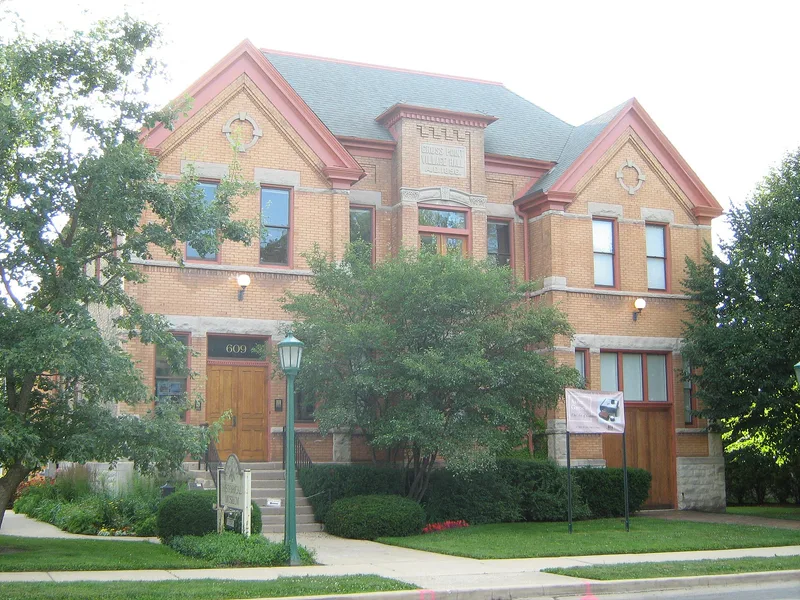
Built in 1896 on Ridge Road in what is now Wilmette, Illinois, this two-story brick building served as the village hall of Gross Point, a German immigrant farming community incorporated in 1874. A high rock-faced stone foundation supports orange-brown face brick walls, a hipped roof with gabled ends, and carved stone details. One gabled end held the village offices and the other the fire department, while the basement contained a jail and the second floor a large room used for meetings, dances and parties. Alb. Fischer was the architect and Joseph Heinzen, a local tavern owner and contractor, handled the masonry. Gross Point relied on liquor taxes from its many taverns, and its finances collapsed after road changes, sewer debts and Prohibition. The village was dissolved in 1919, and the hall was sold into private ownership in 1923. It is believed to be the oldest surviving village hall in the north Chicago lakeshore suburbs. The building is now vacant, awaiting restoration as a museum.
Significance in brief: It is locally significant under Criterion A for its association with the political and governmental administration of Gross Point from 1896 until the village was dissolved in 1919. It is thought to be the oldest surviving village hall in the suburban area north of Chicago along Lake Michigan. It also represents typical American town hall design, with administrative space and an assembly room.
Machine-generated summary. This summary was generated by a language model from the official nomination document and has not been reviewed line by line by an editor. It may contain errors. Check the source document before relying on any detail. Source: nomination document (PDF) · National Archives catalog entry. NRHP reference 91001001, listed August 5, 1991. Summary generated October 2026 (model claude-sonnet-5-5, prompt v1.0-2026-10-29, confidence high).
Key facts
| Address | 609 Ridge Rd., Wilmette |
|---|---|
| County | Cook County |
| Listed | August 5, 1991 |
| Reference number | 91001001 |
| Resource type | Building |
| Period of significance | 1896-1919 |
| Architect / builder | Fischer, Alb. - Architect; Heinzen, Joseph - Builder |
| Architectural style | Late Victorian |
| Criteria |
|
| Areas of significance | Politics/Government |
| Level of significance | Local |
| Status (as stated in the nomination) | The building is vacant, awaiting complete restoration as the Wilmette Historical Museum. |
| Acreage | 0.9 |
| Coordinates | 42.07582, -87.72284 (NPS GIS) |
What listing means for this property
National Register listing is honorary for a privately owned home: it does not by itself restrict what an owner may do with their own money, and it does not require public access. Restrictions come from local landmark or historic-district ordinances, which are separate (how they differ).
Owner-occupied houses are not eligible for the 20% federal rehabilitation tax credit, which applies to income-producing buildings, but many states offer credits for homeowners. Listing also opens the door to preservation easements and to buying a plaque. Start with what listing means for homeowners, renovating a listed house and selling one.
Noted as vacant in the nomination. Nomination documents can be decades old; current status may differ. If you are considering buying an empty listed property, read the due-diligence checklist.
General information, not legal or tax advice. Rules change; confirm with your State Historic Preservation Office or a qualified adviser.
Sources and further reading
- National Park Service, National Register of Historic Places database (snapshot May 2026), reference 91001001.
- Nomination form (PDF, National Archives) — catalog entry
- Wikipedia article (used for cross-checking only; text not reproduced here)
- Wikidata Q85764648
- This listing as JSON
Last updated October 2026. Found an error? See the editorial policy for how to report it.