Wilson, Woodrow, Boyhood Home

Why it's listed
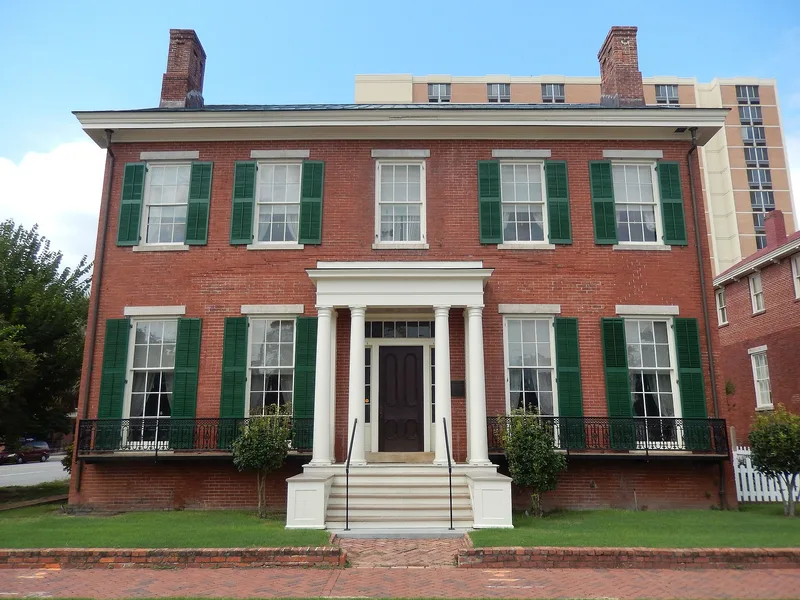
This two-story red-brick house at 419 Seventh Street in Augusta, Georgia, dates to about 1840 and served as the Presbyterian manse where Woodrow Wilson spent his boyhood. Wilson arrived in 1858 at age two, when his father, the Reverend Joseph R. Wilson, became pastor of the First Presbyterian Church diagonally across the street. The family stayed until 1870. The house has a one-story porch on slender Tuscan columns, white stone window lintels, six-over-six windows, and a central-hall plan. Its broad proportions and low roof recall earlier Jeffersonian classical styles. A two-story brick kitchen, now joined to the house by a frame room, and a brick carriage house remain on the lot. A 1927 biographer described the hall, parlor, study and the boy's upstairs room, and these spaces can still be seen. Wilson himself recalled standing at the gateway here as a child when Lincoln's election was announced. The house is valued for that association and for its well-crafted brickwork.
Significance in brief: The nomination argues the house is significant as the boyhood home of Woodrow Wilson, the twenty-seventh U.S. president, who lived there from 1858 to 1870 while his father was pastor of the First Presbyterian Church across the street. It also describes the house as a mid-nineteenth-century classical revival structure with fine red-brick craftsmanship that adds to its urban setting.
Machine-generated summary. This summary was generated by a language model from the official nomination document and has not been reviewed line by line by an editor. It may contain errors. Check the source document before relying on any detail. Source: nomination document (PDF) · National Archives catalog entry. NRHP reference 79000746, listed February 28, 1979. Summary generated October 2026 (model claude-sonnet-5-5, prompt v1.0-2026-10-29, confidence medium).
Key facts
| Address | 419 7th St., Augusta |
|---|---|
| County | Richmond County |
| Listed | February 28, 1979 |
| Reference number | 79000746 |
| Resource type | Building |
| Period of significance | 1858-1870 |
| Architectural style | Classical revival (mid-nineteenth century), with Jeffersonian classical influences |
| Areas of significance | Architecture, Social History |
| Level of significance | National |
| National Historic Landmark | Yes, designated October 6, 2008 |
| Status (as stated in the nomination) | Rated good condition and listed as a private residence; at the time of nomination it had recently been sold and the new owners were restoring it, planning to open it as a historic site. |
| Acreage | 0.9 |
| Within district | Augusta Downtown Historic District |
| Coordinates | 33.47170, -81.96519 (NPS GIS) |
What listing means for this property
National Register listing is honorary for a privately owned home: it does not by itself restrict what an owner may do with their own money, and it does not require public access. Restrictions come from local landmark or historic-district ordinances, which are separate (how they differ).
Owner-occupied houses are not eligible for the 20% federal rehabilitation tax credit, which applies to income-producing buildings, but many states offer credits for homeowners. Listing also opens the door to preservation easements and to buying a plaque. Start with what listing means for homeowners, renovating a listed house and selling one.
General information, not legal or tax advice. Rules change; confirm with your State Historic Preservation Office or a qualified adviser.
Sources and further reading
- National Park Service, National Register of Historic Places database (snapshot May 2026), reference 79000746.
- Nomination form (PDF, National Archives) — catalog entry
- Wikipedia article (used for cross-checking only; text not reproduced here)
- Wikidata Q8033191
- This listing as JSON
Last updated October 2026. Found an error? See the editorial policy for how to report it.