Augusta Downtown Historic District

The pin is a point inside the NPS boundary polygon, not a surveyed location.
Why it's listed
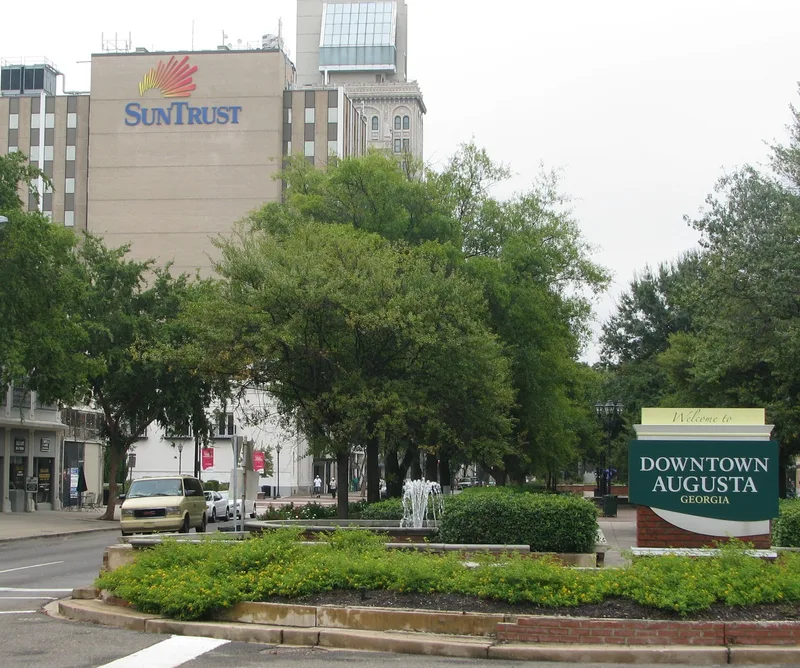
Downtown Augusta, Georgia, is preserved as a single historic district running from 5th to 13th Street along the Savannah River. The city was laid out in 1736 on a gridiron plan, and the district follows its three main avenues. Broad Street is the commercial corridor, with rows of storefronts from the 1820s to the 1960s, ranging from Federal-style shops with dwellings above to Italianate blocks, Art Deco theaters and an 18-story steel-and-glass bank tower completed in 1967. Greene Street is a tree-lined boulevard with a landscaped median, churches, public buildings and large nineteenth-century houses. Telfair Street holds landmarks such as the Academy of Richmond County and the Medical College of Georgia. Riverside warehouses, a levee section and railroad bridges reflect the cotton trade and the railroad that made Augusta a major inland market. The district gathers seventeen individually listed properties, two earlier districts and one National Historic Landmark, along with hundreds of other buildings, sites, structures and objects.
Significance in brief: The nomination brings together all surviving intact resources of downtown Augusta, a city laid out in 1736, in a single district. Broad Street is presented as the commercial heart of Georgia's second oldest city, tied to the cotton trade, river transport and the railroad. The district also holds a wide range of architectural styles from the 1820s through the 1960s, including a notable group of International Style buildings from the 1950s and 1960s.
Machine-generated summary. This summary was generated by a language model from the official nomination document and has not been reviewed line by line by an editor. It may contain errors. Check the source document before relying on any detail. Source: nomination document (PDF) · National Archives catalog entry. NRHP reference 04000515, listed June 11, 2004. Summary generated October 2026 (model claude-sonnet-5-5, prompt v1.0-2026-10-29, confidence medium).
Key facts
| Address | Roughly bounded by 13th St., Gordon Hwy, Walton Way and the Savannah R., Augusta |
|---|---|
| County | Richmond County |
| Listed | June 11, 2004 |
| Reference number | 04000515 |
| Resource type | District |
| Architect / builder | G. Lloyd Preacher (Goldberg, Chronicle/Marion, Herald, Modjeska and Imperial buildings; Lamar Building with W. L. Stoddard); Robert McCreary (Georgia Railroad and Banking Company tower, 1967) |
| Architectural style | Federal, Greek Revival, Gothic Revival, Exotic Revival, Italianate, Second Empire, Queen Anne, Romanesque, Beaux Arts, Italian Renaissance, Commercial Style, Bungalow/Craftsman, Moderne, International Style, Art Deco |
| Areas of significance | Architecture, Landscape Architecture, Commerce, Politics/Government, Education, Transportation, Community Planning and Development |
| Level of significance | National, State, Local |
| Status (as stated in the nomination) | Many buildings remain in use; current functions listed include commerce, government, religion, education, housing and industry. |
| Acreage | 300 |
| Within district | Broad Street Historic District |
| Coordinates | 33.47406, -81.96274 (NPS GIS) |
What listing means for this property
This is a historic district. Buildings within its boundary are either contributing (they add to the district's significance) or non-contributing. Owners of contributing income-producing buildings can claim the 20% federal rehabilitation tax credit; homeowners should look at state credits. National Register districts impose no design review by themselves; a local historic district ordinance, if one exists, does (the difference explained).
General information, not legal or tax advice. Rules change; confirm with your State Historic Preservation Office or a qualified adviser.
Sources and further reading
- National Park Service, National Register of Historic Places database (snapshot May 2026), reference 04000515.
- Nomination form (PDF, National Archives) — catalog entry
- Wikipedia article (used for cross-checking only; text not reproduced here)
- Wikidata Q4820916
- This listing as JSON
Last updated October 2026. Found an error? See the editorial policy for how to report it.