Sacred Heart Catholic Church

Why it's listed
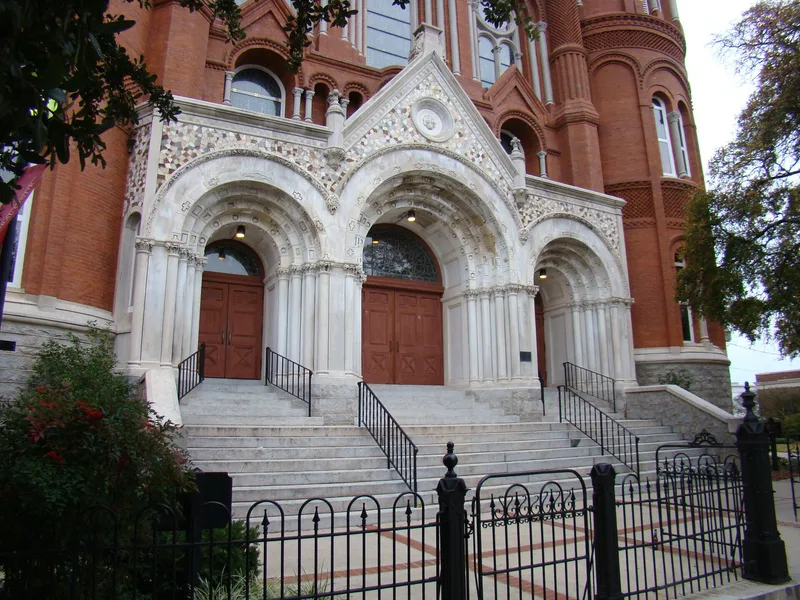
Sacred Heart Catholic Church occupies the northwest corner of Greene and 13th Streets in Augusta, Georgia. Its cornerstone was laid in 1898, and it was dedicated in 1900 and consecrated in 1907. Brother Otten, a Jesuit lay brother who also designed St. Joseph's Church in Macon, was the architect. The nomination praises the exterior brickwork, which uses many patterns and custom-made brick sizes produced by artisans brought from Munich. The interior follows a neo-Romanesque design, with altars carved in Italy and stained glass from Germany. The parish began in 1874 as Irish immigration outgrew St. Patrick's Church. Jesuit priests ran a degree-granting college, a charitable St. Vincent de Paul Society operated here, and the church became a cultural center known for its music and preaching. Prominent Augustans, including Senator Patrick Walsh and poet James Ryder Randall, belonged to the parish.
Significance in brief: The nomination argues the church is an outstanding example of late 19th century eclectic brick architecture, with more than fifteen patterns of brickwork and Romanesque influences. It also notes the parish's long role as a cultural, educational and charitable center in Augusta, and its link to Jesuit-designed churches such as St. Joseph's in Macon.
Machine-generated summary. This summary was generated by a language model from the official nomination document and has not been reviewed line by line by an editor. It may contain errors. Check the source document before relying on any detail. Source: nomination document (PDF) · National Archives catalog entry. NRHP reference 72000399, listed March 16, 1972. Summary generated October 2026 (model claude-sonnet-5-5, prompt v1.0-2026-10-29, confidence medium).
Key facts
| Address | Greene and 13th Sts., Augusta |
|---|---|
| County | Richmond County |
| Listed | March 16, 1972 |
| Reference number | 72000399 |
| Resource type | Building |
| Period of significance | 1898-1900 |
| Architect / builder | Brother Otten, Jesuit lay brother (brick made by artisans from Munich using the Halger Brick Company facilities) |
| Architectural style | Eclectic with Romanesque and neo-Romanesque influences; Victorian |
| Areas of significance | Architecture, Social History |
| Level of significance | State |
| Status (as stated in the nomination) | Listed in good condition, unaltered, on its original site, and occupied as a religious building at the time of nomination; a cover letter says it was threatened with abandonment by a changing parish. |
| Acreage | 1 |
| Within district | Augusta Canal Industrial District |
| Coordinates | 33.47729, -81.97666 (NPS GIS) |
What listing means for this property
Religious properties are listed for their architectural or historical significance, not their religious use. Listing is honorary and does not restrict the congregation's use of the building. The federal rehabilitation credit is generally unavailable unless part of the building is income-producing; some state programmes and preservation grants do cover religious buildings. Federal funding or permits trigger Section 106 review.
General information, not legal or tax advice. Rules change; confirm with your State Historic Preservation Office or a qualified adviser.
Sources and further reading
- National Park Service, National Register of Historic Places database (snapshot May 2026), reference 72000399.
- Nomination form (PDF, National Archives) — catalog entry
- Wikipedia article (used for cross-checking only; text not reproduced here)
- Wikidata Q7397189
- This listing as JSON
Last updated October 2026. Found an error? See the editorial policy for how to report it.