Pinched Gut Historic District

Why it's listed
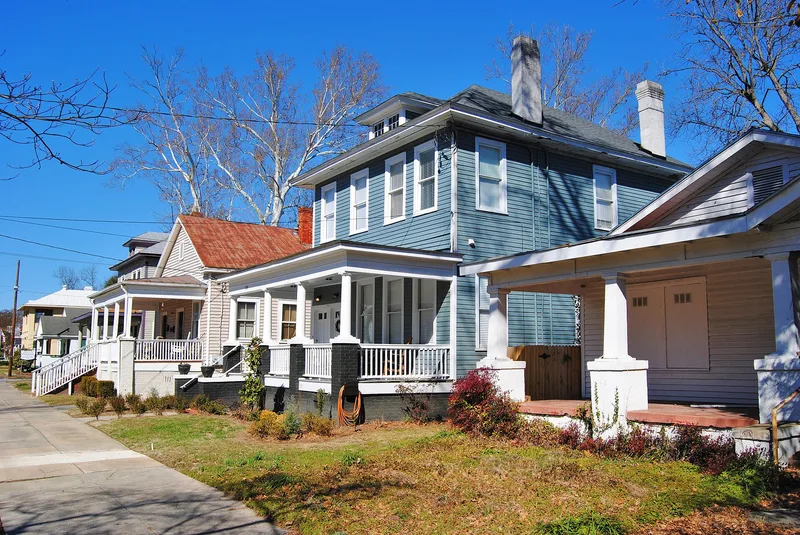
Pinched Gut, known locally as P.G., is the east end of downtown Augusta, Georgia. The district takes in about fifty-one city blocks laid out on a grid, May Park, and Magnolia and Cedar Grove cemeteries. Its houses range from large two-story townhouses to small shotgun cottages and span Federal, Greek Revival, Victorian, Neoclassical and Bungalow styles, built from the early 1800s through the 1930s. Greene and Broad streets have landscaped medians and tree canopies. May Park served as Augusta's parade ground for most of the nineteenth century. Houghton School grew from a free school established in 1851, and the Thankful Baptist Church traces to an African Baptist congregation founded in 1840. The 1916 fire destroyed many antebellum homes north of Greene Street, and less affluent residents rebuilt there afterward. The district was recognized as the largest and most intact historic residential area in the city.
Significance in brief: The nomination calls it the largest and most intact historic residential area in Augusta, with every domestic style from Federal to Bungalow. It also argues significance in landscape architecture, community planning, military history, education and religion, citing the medianed Greene and Broad streets, the cemeteries, May Park, Houghton School and the Thankful Baptist Church.
Machine-generated summary. This summary was generated by a language model from the official nomination document and has not been reviewed line by line by an editor. It may contain errors. Check the source document before relying on any detail. Source: nomination document (PDF) · National Archives catalog entry. NRHP reference 80001228, listed March 6, 1980. Summary generated October 2026 (model claude-sonnet-5-5, prompt v1.0-2026-10-29, confidence medium).
Key facts
| Address | Roughly bounded by Gordon Hwy., E. Boundary, Reynolds and Gwinnett Sts., Augusta |
|---|---|
| County | Richmond County |
| Listed | March 6, 1980 |
| Reference number | 80001228 |
| Resource type | District |
| Period of significance | 19th- and early-20th centuries |
| Architectural style | Federal, Greek Revival, Italianate, Victorian, Neoclassical, Bungalow, Spanish Colonial Revival |
| Areas of significance | Community Planning and Development, Landscape Architecture, Military, Architecture |
| Level of significance | Local |
| Status (as stated in the nomination) | Mainly residential and described as the most substantial intact residential neighborhood in downtown Augusta; thirteen intrusions are listed, mostly along the eastern boundary. |
| Acreage | 300 |
| Coordinates | 33.46783, -81.95432 (NPS GIS) |
What listing means for this property
This is a historic district. Buildings within its boundary are either contributing (they add to the district's significance) or non-contributing. Owners of contributing income-producing buildings can claim the 20% federal rehabilitation tax credit; homeowners should look at state credits. National Register districts impose no design review by themselves; a local historic district ordinance, if one exists, does (the difference explained).
General information, not legal or tax advice. Rules change; confirm with your State Historic Preservation Office or a qualified adviser.
Sources and further reading
- National Park Service, National Register of Historic Places database (snapshot May 2026), reference 80001228.
- Nomination form (PDF, National Archives) — catalog entry
- Wikidata Q49542708
- This listing as JSON
Last updated October 2026. Found an error? See the editorial policy for how to report it.