South Railroad Historic District

The pin is a point inside the NPS boundary polygon, not a surveyed location.
Why it's listed
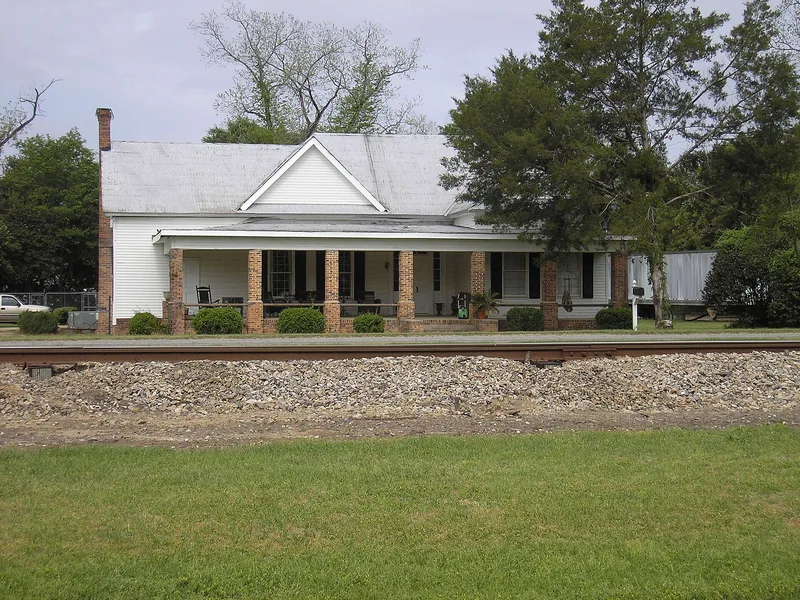
Seven modest houses and a masonry service station line both sides of the railroad tracks south of Baconton's commercial center, forming a narrow district of about 22 acres. Most buildings are frame, no taller than one and one-half stories, and designed in late Victorian or Craftsman/Bungalow styles by local craftsmen. The land was once owned by Major Robert J. Bacon, who sold roughly 200 acres to John R. Pinson, Sr.; the Pinsons built here in 1902, and members of the Glausier family built several houses soon after. The railroad, laid in 1869-70, gave rise to the town, and the Dixie Highway, paved in 1927-28 as the first paved road in Mitchell County outside city streets, prompted the service station's construction in 1927. Lawns, trees and a pecan grove give the area its landscape character. It remains one of only two historic residential neighborhoods in Baconton.
Significance in brief: The district shows the local carpenter tradition in late Victorian and Craftsman/Bungalow houses typical of small south Georgia towns. It also reflects the railroad and the 1927-28 paved Dixie Highway, a characteristic linear railroad-town layout, a pecan grove landscape, and ties to the Bacon and Glausier families.
Machine-generated summary. This summary was generated by a language model from the official nomination document and has not been reviewed line by line by an editor. It may contain errors. Check the source document before relying on any detail. Source: nomination document (PDF) · National Archives catalog entry. NRHP reference 83003597, listed December 1, 1983. Summary generated October 2026 (model claude-sonnet-5-5, prompt v1.0-2026-10-29, confidence high).
Key facts
| Address | S. Railroad Ave., GA 3, and Seaboard Coast Line RR tracks, Baconton |
|---|---|
| County | Mitchell County |
| Listed | December 1, 1983 |
| Reference number | 83003597 |
| Resource type | District |
| Period of significance | ca. 1900-1927 |
| Architect / builder | Architect unknown; builders Thomas Jefferson Glausier and others |
| Architectural style | Late Victorian and Craftsman/Bungalow |
| Areas of significance | Community Planning and Development, Landscape Architecture, Transportation, Architecture |
| Level of significance | Local |
| Status (as stated in the nomination) | Occupied and in residential use; one house is covered with paneling and one modern ranch-style house is non-historic. |
| Acreage | 22 |
| Coordinates | 31.37122, -84.16398 (NPS GIS) |
What listing means for this property
This is a historic district. Buildings within its boundary are either contributing (they add to the district's significance) or non-contributing. Owners of contributing income-producing buildings can claim the 20% federal rehabilitation tax credit; homeowners should look at state credits. National Register districts impose no design review by themselves; a local historic district ordinance, if one exists, does (the difference explained).
General information, not legal or tax advice. Rules change; confirm with your State Historic Preservation Office or a qualified adviser.
Sources and further reading
- National Park Service, National Register of Historic Places database (snapshot May 2026), reference 83003597.
- Nomination form (PDF, National Archives) — catalog entry
- Wikipedia article (used for cross-checking only; text not reproduced here)
- Wikidata Q29095043
- This listing as JSON
Last updated October 2026. Found an error? See the editorial policy for how to report it.