Baconton Commercial Historic District

The pin is a point inside the NPS boundary polygon, not a surveyed location.
Why it's listed
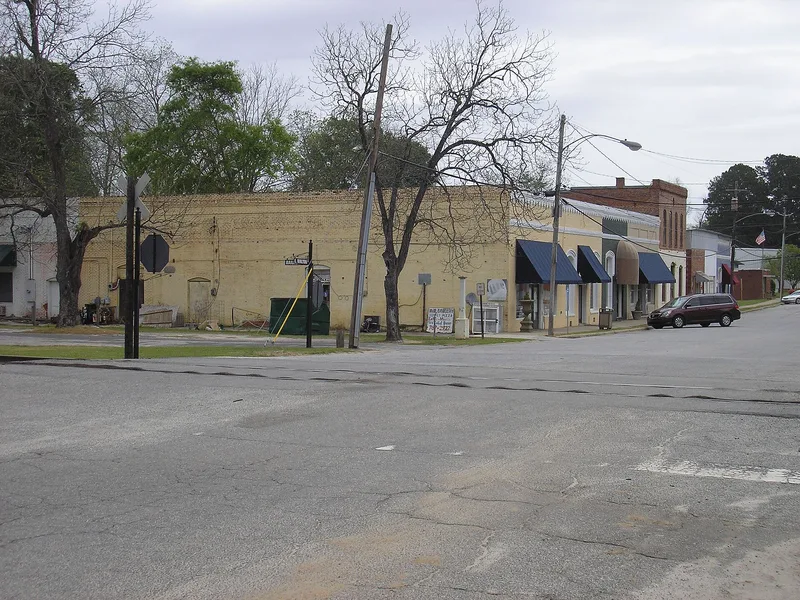
Baconton's commercial district sits in the middle of town beside the north-south railroad tracks. The town began in 1869-1870 when the railroad arrived, and its first wooden business houses were gradually replaced by brick buildings beginning in 1902 with Jackson Supply Company's two-story store on Walton Street. Adjoining one- and two-story brick stores along Walton and North Railroad Streets share a contiguous sidewalk beneath metal awnings, and they display brick corbelling, arched windows and cast iron storefronts. The district also includes a large brick warehouse, the Bacon and Jackson pecan cracking plant of 1919, a former hotel and a bookkeeper's house, both now residences. It was listed for its role in agriculture, architecture and commerce: pecans have been shelled, stored, processed and sold here since at least 1919, and the district once held stores, banks, a post office and doctors' offices. Some storefronts are now empty, and the depot was demolished in the 1970s.
Significance in brief: The district was the center of business, commerce and agri-business, especially pecan processing, for Baconton and the surrounding area. Its brick commercial row buildings with cast iron storefronts and corbelling are typical of early twentieth century commercial architecture in Southwest Georgia.
Machine-generated summary. This summary was generated by a language model from the official nomination document and has not been reviewed line by line by an editor. It may contain errors. Check the source document before relying on any detail. Source: nomination document (PDF) · National Archives catalog entry. NRHP reference 83003603, listed December 1, 1983. Summary generated October 2026 (model claude-sonnet-5-5, prompt v1.0-2026-10-29, confidence high).
Key facts
| Address | E. Walton and E. Durham Sts., N. Railroad and S. Railroad Aves., and GA 3, Baconton |
|---|---|
| County | Mitchell County |
| Listed | December 1, 1983 |
| Reference number | 83003603 |
| Resource type | District |
| Architect / builder | Architect unknown; builder probably Thomas Jefferson Glausier; W.J. Mullins was also a contractor in town |
| Architectural style | Early twentieth century commercial architecture typical of South Georgia towns |
| Areas of significance | Commerce, Architecture, Agriculture |
| Level of significance | Local |
| Status (as stated in the nomination) | Condition fair: structurally sound but in need of cosmetic repair and routine maintenance. Partly used in its original commercial capacities, with several empty store buildings; the former hotel and bookkeeper's house are single family residences. |
| Acreage | 10 |
| Coordinates | 31.37585, -84.16121 (NPS GIS) |
What listing means for this property
This is a historic district. Buildings within its boundary are either contributing (they add to the district's significance) or non-contributing. Owners of contributing income-producing buildings can claim the 20% federal rehabilitation tax credit; homeowners should look at state credits. National Register districts impose no design review by themselves; a local historic district ordinance, if one exists, does (the difference explained).
General information, not legal or tax advice. Rules change; confirm with your State Historic Preservation Office or a qualified adviser.
Sources and further reading
- National Park Service, National Register of Historic Places database (snapshot May 2026), reference 83003603.
- Nomination form (PDF, National Archives) — catalog entry
- Wikipedia article (used for cross-checking only; text not reproduced here)
- Wikidata Q29095040
- This listing as JSON
Last updated October 2026. Found an error? See the editorial policy for how to report it.