Carnegie Library of Barnesville

Why it's listed
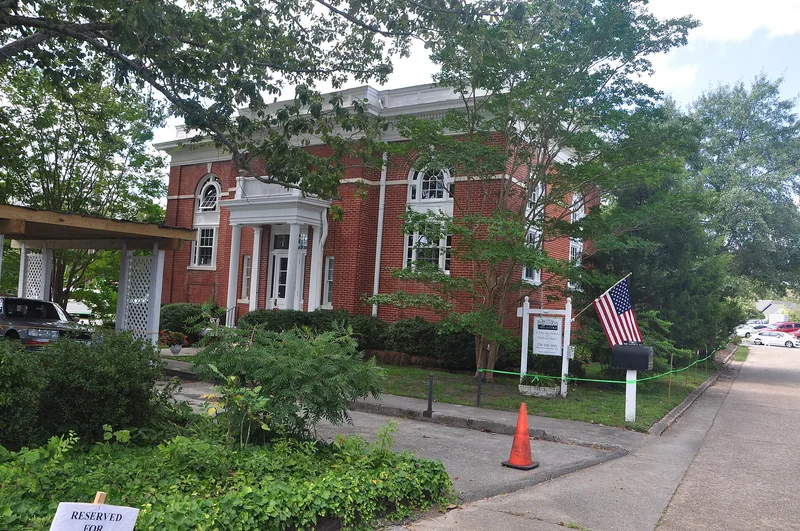
Built in 1910, the Carnegie Library of Barnesville is a two-story red brick building in a modified Georgian style, with wooden porticos on white columns, marble trim and bands, and Palladian windows. It came about after local citizen Rosa Middlebrooks wrote to Andrew Carnegie in 1908, and he offered $10,000 if the city committed to maintaining the library. The New York firm Whitfield and King designed it, and Barnesville Coal and Lumber Company built it for a bid of $6,709. It was the town's first free public library and is one of only twenty-four Carnegie libraries in Georgia. Beyond lending books, it hosted civic groups, wartime book drives, Red Cross classes and art exhibits. It joined the Flint River Regional Library System in 1971. Changes include lowered ceilings, modern lighting and new floor coverings, but the original oak columns, paneled doors and narrow stairs remain. It is listed for its architecture and its role in local education and community life.
Significance in brief: The nomination argues it is a fine example of the Carnegie-supported libraries built in American towns and the work of a nationally known architectural firm. It is also significant in education and social/humanitarian history as Barnesville's first free public library and a community meeting place. It is one of only twenty-four Carnegie libraries built in Georgia.
Machine-generated summary. This summary was generated by a language model from the official nomination document and has not been reviewed line by line by an editor. It may contain errors. Check the source document before relying on any detail. Source: nomination document (PDF) · National Archives catalog entry. NRHP reference 86003684, listed February 3, 1987. Summary generated October 2026 (model claude-sonnet-5-5, prompt v1.0-2026-10-29, confidence high).
Key facts
| Address | Library St., Barnesville |
|---|---|
| County | Lamar County |
| Listed | February 3, 1987 |
| Reference number | 86003684 |
| Resource type | Building |
| Period of significance | 1900- (specific date 1910) |
| Architect / builder | Whitfield and King (architects, New York City); Barnesville Coal and Lumber Company (contractor) |
| Architectural style | Modified Georgian |
| Criteria |
|
| Areas of significance | Education, Architecture, Social History |
| Level of significance | Local |
| Status (as stated in the nomination) | Occupied and in use as a public library; condition listed as excellent, with some alterations including lowered ceilings, new floor coverings and replaced exterior columns in 1984. |
| Acreage | 0.9 |
| Within district | Thomaston Street Historic District |
| Coordinates | 33.05284, -84.15813 (NPS GIS) |
What listing means for this property
For a publicly owned building or structure, listing mainly matters when federal funds, permits or licences are involved: projects then go through Section 106 review so effects on the property are considered. Listing also strengthens applications for preservation grants and, for leased income-producing uses, can enable the federal rehabilitation tax credit.
General information, not legal or tax advice. Rules change; confirm with your State Historic Preservation Office or a qualified adviser.
Sources and further reading
- National Park Service, National Register of Historic Places database (snapshot May 2026), reference 86003684.
- Nomination form (PDF, National Archives) — catalog entry
- Wikipedia article (used for cross-checking only; text not reproduced here)
- Wikidata Q5043942
- This listing as JSON
Last updated October 2026. Found an error? See the editorial policy for how to report it.