Barnesville Commercial Historic District
Also known as: See Also:Barnesville Depot

Why it's listed
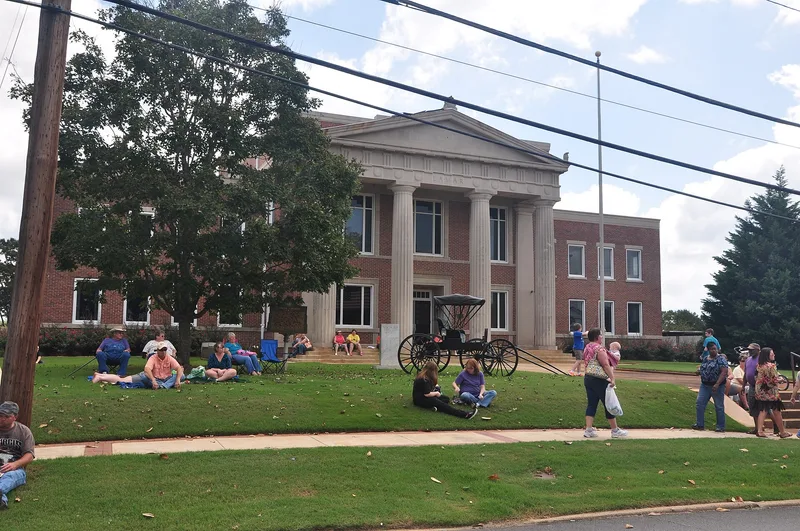
Downtown Barnesville, the seat of Lamar County in Middle Georgia, grew around a crossroads and a diagonal railroad line, and its historic core survives as a district of 53 contributing buildings. Most are one- to two-story brick commercial rows with shared party walls and uniform setbacks, many with ornate Italianate detailing such as pressed-metal cornices and decorative parapets. Standouts include the 1891 Jackson G. Smith buggy building, the 1905 M. W. Smith Building, the 1897 Presbyterian Church, the 1884 city hall and fire station, the 1913 Mission-style depot and the 1918 Colonial Revival post office. The district reflects the town's economy: Barnesville produced more buggies than any place south of Cincinnati, and cotton and knitting mills, warehouses and rail freight also shaped it. In 1938 President Franklin D. Roosevelt visited to start the first Rural Electrification Administration project. The period of significance begins with the 1826 town plan and runs to 1945, and only eight of the resources are noncontributing.
Significance in brief: The district is argued to be significant for its intact concentration of commercial row buildings and community landmark buildings, and for its eclectic mix of architectural styles, notably Italianate. It also reflects Barnesville's role in commerce, the buggy and knitting industries, rail and road transportation, and local and federal government. Barnesville was once called the 'Buggy Capital of the South.'
Machine-generated summary. This summary was generated by a language model from the official nomination document and has not been reviewed line by line by an editor. It may contain errors. Check the source document before relying on any detail. Source: nomination document (PDF) · National Archives catalog entry. NRHP reference 95000733, listed June 20, 1995. Summary generated October 2026 (model claude-sonnet-5-5, prompt v1.0-2026-10-29, confidence high).
Key facts
| Address | Roughly bounded by College, Taylor and Market Sts. and the Central of GA RR tracks, Barnesville |
|---|---|
| County | Lamar County |
| Listed | June 20, 1995 |
| Reference number | 95000733 |
| Resource type | District |
| Period of significance | 1826-1945 |
| Architect / builder | Post Office: James A. Wetmore, United States Acting Supervising Architect |
| Architectural style | Late Victorian (Italianate, Gothic, Romanesque), Colonial Revival, Classical Revival, Mission, Art Deco, Commercial Vernacular Victorian, Stripped Classical, 20th Century Commercial |
| Criteria |
|
| Areas of significance | Architecture, Commerce, Industry, Politics/Government, Transportation |
| Level of significance | State, Local |
| Status (as stated in the nomination) | Most historic buildings remain intact and in use as commercial space, city hall, fire station, post office, church and storage; successors to historic businesses keep the district operating as a commercial center. |
| Acreage | 15 |
| Coordinates | 33.05705, -84.15563 (NPS GIS) |
What listing means for this property
This is a historic district. Buildings within its boundary are either contributing (they add to the district's significance) or non-contributing. Owners of contributing income-producing buildings can claim the 20% federal rehabilitation tax credit; homeowners should look at state credits. National Register districts impose no design review by themselves; a local historic district ordinance, if one exists, does (the difference explained).
General information, not legal or tax advice. Rules change; confirm with your State Historic Preservation Office or a qualified adviser.
Sources and further reading
- National Park Service, National Register of Historic Places database (snapshot May 2026), reference 95000733.
- Nomination form (PDF, National Archives) — catalog entry
- Wikidata Q141771906
- This listing as JSON
Last updated October 2026. Found an error? See the editorial policy for how to report it.