Barnesville Depot
Barnesville Depot is a building in Barnesville, Lamar County, Georgia, listed on the National Register of Historic Places on April 30, 1986 (reference number 86000916). The National Park Service records its significance in Architecture at the local level.
Facts from the NPS National Register database (); nomination summary October 2026. Last updated . Sources for each fact.

Approximate location: the National Park Service places this pin arbitrarily within the property, not at a surveyed point (stated accuracy ±12 m).
Why it's listed
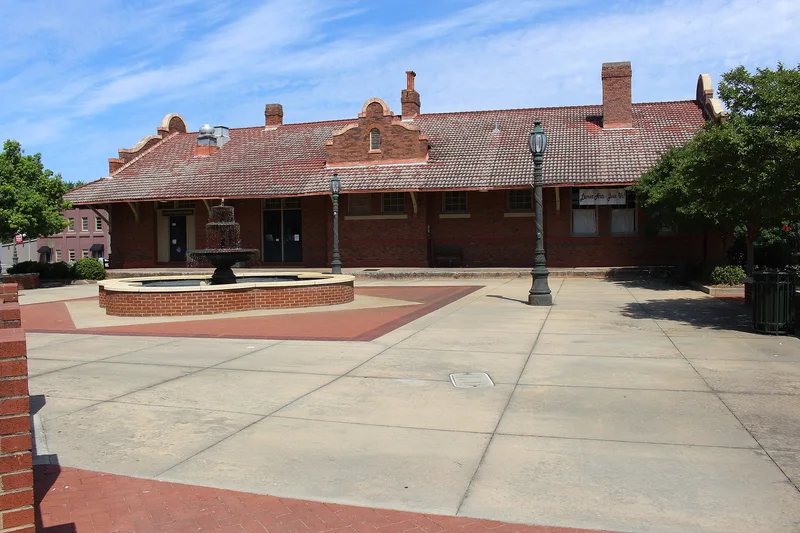
Built in 1913 beside the tracks in central Barnesville, this brick passenger depot served a small agricultural and commercial center. It was designed by the Central of Georgia Railroad's Chief Engineer. Its features include wood-framed windows and doors, a fifteen-foot roof overhang carried on large brackets, and scalloped gables. Inside are a large waiting room, a ticket and office section, a smaller waiting room and a baggage room; the two waiting rooms were originally separate for white and Black passengers. The depot replaced a tiny earlier station that passengers had criticized. It was the town's chief tie to the outside world and the setting for local soldiers leaving for World War I, celebrations when Lamar County was created in 1920, and President Franklin D. Roosevelt's 1938 visit to dedicate a rural electric cooperative. Passenger service ended in 1971, and a citizen campaign saved the building from demolition. It was later restored by a local historical society for use as a museum and meeting space.
Significance in brief: The nomination presents it as a good, intact example of a small-town railroad passenger depot with ticket office and waiting rooms. It was the town's main link to the outside world and the site of local events, including World War I troop departures, the celebration of Lamar County's creation in 1920, and President Franklin D. Roosevelt's 1938 arrival.
Machine-generated summary. This summary was generated by a language model from the official nomination document and has not been reviewed line by line by an editor. It may contain errors. Check the source document before relying on any detail. Source: nomination document (PDF) · National Archives catalog entry. NRHP reference 86000916, listed April 30, 1986. Summary generated October 2026 (model claude-sonnet-5-5, prompt v1.0-2026-10-29, confidence high).
Key facts
| Official database NPS National Register database, ref. 86000916 , checked | |
|---|---|
| Address | Plaza Way and Main St., Barnesville |
| County | Lamar County |
| Listed | April 30, 1986 |
| Reference number | 86000916 |
| Resource type | Building |
| Areas of significance | Architecture |
| Level of significance | Local |
| National Historic Landmark | No |
| Acreage | 0.9 |
| Official document, machine-extracted Nomination form (National Archives) , checked | |
| Period of significance | 1912-1913 |
| Architect / builder | Central of Georgia Railroad, Chief Engineer |
| Criteria |
|
| Status (as stated in the nomination) | Undergoing restoration for use as a meeting space and museum after brief use as a restaurant; passenger service ended in 1971. |
| Official dataset NPS cultural-resource GIS (NRHP locations) | |
| Coordinates | 33.05449, -84.15572 |
| Computed Computed from NPS GIS district boundaries | |
| Within district | Barnesville Commercial Historic District |
What listing means for this property
For an income-producing building, listing (individually or as a contributing building in a district) is the gateway to the 20% federal rehabilitation tax credit on qualified rehabilitation costs, often stackable with state credits. Work claiming the credit must follow the Secretary of the Interior's Standards and be approved in advance.
Listing does not restrict a private owner acting without federal money or permits; where federal funding or licensing is involved, Section 106 review applies.
General information, not legal or tax advice. Rules change; confirm with your State Historic Preservation Office or a qualified adviser.
Questions about Barnesville Depot
When was Barnesville Depot added to the National Register of Historic Places?
Barnesville Depot was listed on April 30, 1986. Its National Register reference number is 86000916.
Is Barnesville Depot a National Historic Landmark?
No. The National Park Service database (snapshot of May 2026) lists Barnesville Depot on the National Register but does not record it as a National Historic Landmark.
Where is Barnesville Depot?
Plaza Way and Main St., Barnesville, Lamar County, Georgia; coordinates 33.05449, -84.15572.
Why is Barnesville Depot historically significant?
According to a machine-generated summary of its nomination form: The nomination presents it as a good, intact example of a small-town railroad passenger depot with ticket office and waiting rooms. It was the town's main link to the outside world and the site of local events, including World War I troop departures, the celebration of Lamar County's creation in 1920, and President Franklin D. Roosevelt's 1938 arrival. Check the nomination document before relying on any detail.
Who designed or built Barnesville Depot?
The nomination form names Central of Georgia Railroad, Chief Engineer as architect or builder (extracted by machine from the nomination; check the source document).
Is Barnesville Depot in a historic district?
Yes. Its location falls within the Barnesville Commercial Historic District, itself listed on the National Register. (Computed from National Park Service boundary data; the district nomination's own list of contributing resources may differ.)
Where can I read the original nomination for Barnesville Depot?
The nomination form is a public record held by the National Archives: nomination document (PDF).
Sources and further reading
- National Park Service, National Register of Historic Places database (snapshot May 2026), reference 86000916.
- Nomination form (PDF, National Archives) — catalog entry
- Wikipedia article (used for cross-checking only; text not reproduced here)
- Wikidata Q24197385
- This listing as JSON
Last updated October 2026. Found an error? See the editorial policy for how to report it.