Roswell Historic District
Also known as: See Also:Barrington Hall; Bulloch Hall

Why it's listed
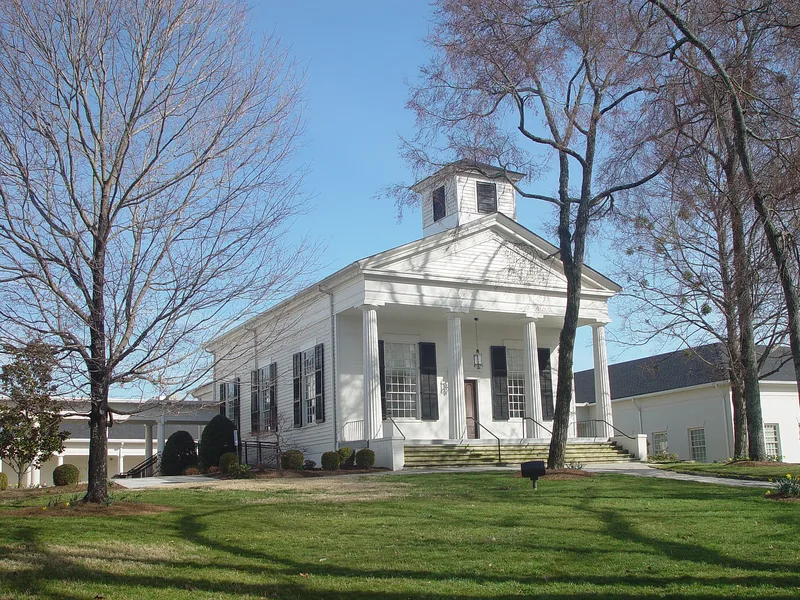
Roswell's historic core, about 120 acres north of Atlanta, began as a planned mill village. Roswell King and his son Barrington King, with six other families from coastal Georgia, founded it in the late 1830s as Native Americans were removed from the area. Big Creek powered a cotton factory and a woolen mill. Around a town square the settlers placed houses, a store, a Presbyterian church, an academy and cemeteries. Builder Willis Ball, from Connecticut, produced several Greek Revival temple-form houses, including Barrington Hall, Bulloch Hall and the church. Mill workers lived in brick apartments known as the Old Bricks and in modest Factory Hill houses. Though the mill burned in 1864 and again in 1929, most other buildings remain much as built. The district was listed because sixteen surviving elements, along with the original street plan and topography, preserve a distinctive antebellum planned manufacturing community with a New England character in the South.
Significance in brief: The nomination argues that the district keeps enough of its original layout and buildings to show a 19th-century planned manufacturing village. It highlights Greek Revival temple-form houses such as Barrington Hall, Bulloch Hall and Mimosa Hall, and the mill-worker housing, stores, churches and cemeteries tied to the Roswell Manufacturing Company. It identifies sixteen elements that together make up historic Roswell.
Machine-generated summary. This summary was generated by a language model from the official nomination document and has not been reviewed line by line by an editor. It may contain errors. Check the source document before relying on any detail. Source: nomination document (PDF) · National Archives catalog entry. NRHP reference 74000682, listed May 2, 1974. Summary generated October 2026 (model claude-sonnet-5-5, prompt v1.0-2026-10-29, confidence medium).
Key facts
| Address | Roughly bounded by Big Creek, King and Dam Sts., SW along New Marietta Hwy., Roswell |
|---|---|
| County | Fulton County |
| Listed | May 2, 1974 |
| Reference number | 74000682 |
| Resource type | District |
| Period of significance | 1837-1973 |
| Architect / builder | Willis Ball, a Connecticut builder-architect (Barrington Hall, Bulloch Hall, Presbyterian Church); Neel Reid restored Mimosa Hall in 1917 |
| Architectural style | Late Georgian and neo-classical; Greek Revival temple-form houses |
| Areas of significance | Community Planning and Development, Landscape Architecture, Architecture |
| Level of significance | National |
| Status (as stated in the nomination) | Condition marked good and largely unaltered, with multiple uses (commercial, residential, religious, museum). The mill complex burned in 1864 and 1929 and survives as ruins and a dam. The Old Mill is not in active use, and the old stores were being restored. |
| Acreage | 120 |
| Coordinates | 34.01523, -84.36146 (NPS GIS) |
What listing means for this property
This is a historic district. Buildings within its boundary are either contributing (they add to the district's significance) or non-contributing. Owners of contributing income-producing buildings can claim the 20% federal rehabilitation tax credit; homeowners should look at state credits. National Register districts impose no design review by themselves; a local historic district ordinance, if one exists, does (the difference explained).
General information, not legal or tax advice. Rules change; confirm with your State Historic Preservation Office or a qualified adviser.
Sources and further reading
- National Park Service, National Register of Historic Places database (snapshot May 2026), reference 74000682.
- Nomination form (PDF, National Archives) — catalog entry
- Wikipedia article (used for cross-checking only; text not reproduced here)
- Wikidata Q104690975
- This listing as JSON
Last updated October 2026. Found an error? See the editorial policy for how to report it.