Chieftains
Also known as: Major Ridge House

Why it's listed
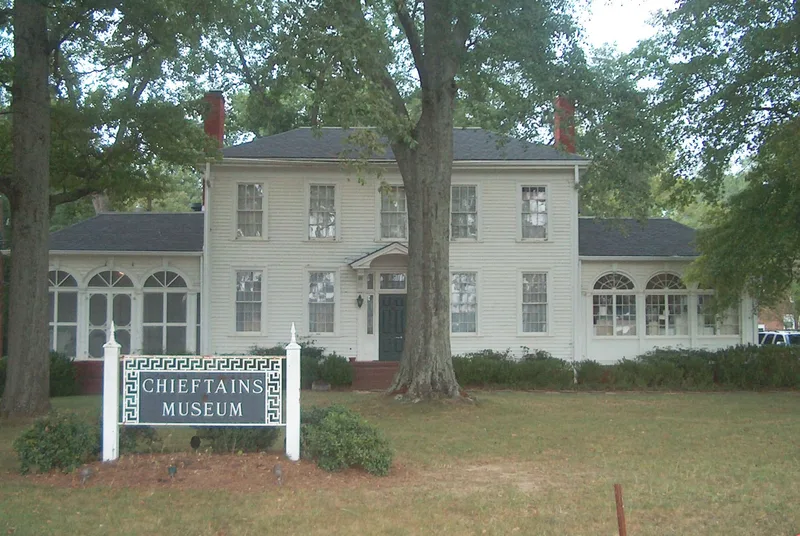
Chieftains, at 80 Chatillon Road north of Rome, Georgia, began about 1792 as a hand-hewn log cabin built by a Cherokee chief beside the Oostanaula River. The logs, nine to ten inches thick, still lie inside the walls of today's two-story white clapboard house. Major Ridge, a Cherokee leader who served with Andrew Jackson in the Creek War of 1814, enlarged the cabin into a painted, columned home. He also operated the area's first trading post and a ferry, and an 1837 survey of Cherokee property recorded 223 acres, outbuildings, orchards and a nursery. Ridge became Speaker of the National Council and supported the removal treaty he signed in 1835. Local tradition holds that a council on the treaty met at the house and that Cherokees gathered there before the Trail of Tears. Later owners remodeled it, and a 1923 Georgian Colonial restyling added side wings. It now serves as a Cherokee history museum.
Significance in brief: It was the home of Major Ridge, a Cherokee chief and Speaker of the National Council, who ran a trading post and ferry here and lived in the style of a Southern plantation owner. The house is tied to Cherokee political life, including a reported council on the removal treaty, and shows the blending of Cherokee and white lifestyles. Its changing form reflects successive architectural fashions.
Machine-generated summary. This summary was generated by a language model from the official nomination document and has not been reviewed line by line by an editor. It may contain errors. Check the source document before relying on any detail. Source: nomination document (PDF) · National Archives catalog entry. NRHP reference 71000273, listed April 7, 1971. Summary generated October 2026 (model claude-sonnet-5-5, prompt v1.0-2026-10-29, confidence high).
Key facts
| Address | 80 Chatillon Rd., Rome |
|---|---|
| County | Floyd County |
| Listed | April 7, 1971 |
| Reference number | 71000273 |
| Resource type | Building |
| Architect / builder | Built by a Cherokee chief (Major Ridge); 1920s remodeling by Lockwood and Poundstone of Atlanta |
| Architectural style | Georgian Colonial restyling over an original log cabin |
| Areas of significance | Native American, Politics/Government, Architecture |
| Level of significance | National |
| National Historic Landmark | Yes, designated November 7, 1973 |
| Status (as stated in the nomination) | Excellent condition, unaltered, on its original site; owned by a service league and used as a museum, with plans to restore it to its Major Ridge-era appearance. |
| Acreage | 0.9 |
| Coordinates | 34.28620, -85.17218 (NPS GIS) |
What listing means for this property
National Register listing is honorary: it recognises significance and does not restrict what a private owner may do without federal money or permits. It unlocks the 20% federal rehabilitation tax credit for income-producing buildings, state credits in many states, and Section 106 review when federal agencies are involved. See what listing means in practice.
General information, not legal or tax advice. Rules change; confirm with your State Historic Preservation Office or a qualified adviser.
Sources and further reading
- National Park Service, National Register of Historic Places database (snapshot May 2026), reference 71000273.
- Nomination form (PDF, National Archives) — catalog entry
- Wikipedia article (used for cross-checking only; text not reproduced here)
- Wikidata Q5097132
- This listing as JSON
Last updated October 2026. Found an error? See the editorial policy for how to report it.