Tift Park

Why it's listed
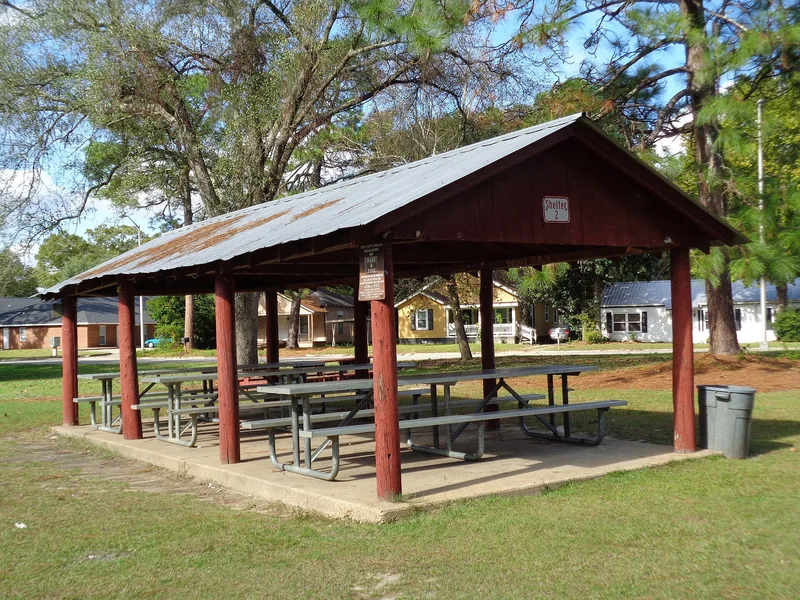
Tift Park is a 31-acre city park about a mile north of downtown Albany, Georgia. The city bought the land in 1909 as part of a beautification campaign and made it Albany's first park. A 1910 naming contest honored Nelson Tift, the city's founder. In 1912 Atlanta landscape architect Otto Katzenstein designed a rustic plan with native plantings, curved carriage drives, a wading pool, a ball field and playgrounds. Live Oaks planted along the drives between 1910 and 1920 and the curving line of Monroe Street still survive. The park reflects the nationwide City Beautiful movement at a local scale. It is also tied to civil rights history. In 1963, after protests by Albany's Black community against segregated public facilities, the city declared the park's 1950s swimming pool and tennis courts surplus and sold them to a private citizen to avoid integration. The period of significance runs from the 1909 land purchase to that 1963 sale.
Significance in brief: The park is significant for community planning and recreation as an example of early 20th-century City Beautiful efforts, and for landscape architecture through its remaining Live Oak-lined carriage drives from Katzenstein's rustic plan. It is also significant in social history and Black ethnic heritage because the city closed and sold its swimming pool and tennis courts in 1963 to avoid desegregation.
Machine-generated summary. This summary was generated by a language model from the official nomination document and has not been reviewed line by line by an editor. It may contain errors. Check the source document before relying on any detail. Source: nomination document (PDF) · National Archives catalog entry. NRHP reference 93001179, listed November 15, 1993. Summary generated October 2026 (model claude-sonnet-5-5, prompt v1.0-2026-10-29, confidence high).
Key facts
| Address | Bounded by N. Jefferson St., 5th Ave., 7th Ave. and Palmyra Rd., Albany |
|---|---|
| County | Dougherty County |
| Listed | November 15, 1993 |
| Reference number | 93001179 |
| Resource type | District |
| Period of significance | 1909 - 1963 |
| Architect / builder | Otto Katzenstein - Landscape Architect |
| Architectural style | No style |
| Criteria |
|
| Areas of significance | Black, Social History, Landscape Architecture, Entertainment/Recreation, Community Planning and Development |
| Level of significance | Local |
| Status (as stated in the nomination) | Still used as a city park with jogging trails, picnic areas, a baseball field and a recreation office. The Albany Boys Club occupies about four acres on the east side. The historic pavilion was demolished in 1986. |
| Acreage | 35 |
| Coordinates | 31.59413, -84.15850 (NPS GIS) |
What listing means for this property
This is a historic district. Buildings within its boundary are either contributing (they add to the district's significance) or non-contributing. Owners of contributing income-producing buildings can claim the 20% federal rehabilitation tax credit; homeowners should look at state credits. National Register districts impose no design review by themselves; a local historic district ordinance, if one exists, does (the difference explained).
General information, not legal or tax advice. Rules change; confirm with your State Historic Preservation Office or a qualified adviser.
Sources and further reading
- National Park Service, National Register of Historic Places database (snapshot May 2026), reference 93001179.
- Nomination form (PDF, National Archives) — catalog entry
- Wikidata Q49570727
- This listing as JSON
Last updated October 2026. Found an error? See the editorial policy for how to report it.