Municipal Auditorium

Why it's listed
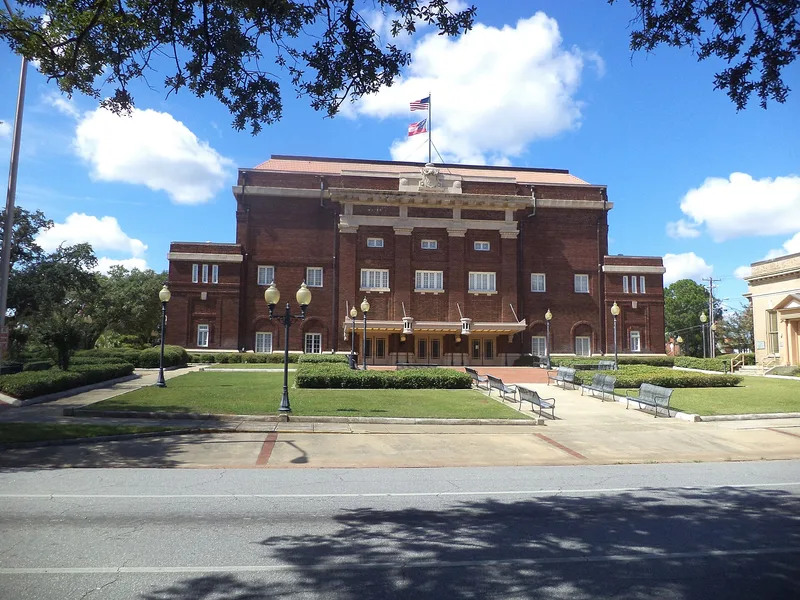
Albany Municipal Auditorium, at 301 Pine Avenue, was built around 1915 to replace an older wooden hall used by the Chautauqua Society, a group offering informal education to people with little schooling. Atlanta architect A. Ten Eyck Brown designed it as a three-story brick rectangle ringed by cubes of varying height, with brick and marble bands and a marquee entrance. Inside, an oval hall held about 1,500 seats in the orchestra, lodge and two balconies. Its large stage was regarded as one of the best in the South, and performers such as Sousa's Band and many touring Broadway productions drew audiences from across South Georgia. Local concerts, graduations and college events also took place there. At the time of nomination the building was closed and vacant, its interior paint peeling, though the structure remained sound and the exterior little changed. The nomination argued for its local importance as a forward-looking early twentieth-century auditorium and noted the threat of demolition and replacement.
Significance in brief: The nomination cites its role in Albany's cultural life for 59 years and its origin as a venue for the Chautauqua Society's informal education programs. It also argues that the severe, streamlined, geometric design was progressive for an early 1900s auditorium. Its stage was considered one of the best in the South, and the building was threatened with demolition at the time of nomination.
Machine-generated summary. This summary was generated by a language model from the official nomination document and has not been reviewed line by line by an editor. It may contain errors. Check the source document before relying on any detail. Source: nomination document (PDF) · National Archives catalog entry. NRHP reference 74000673, listed June 25, 1974. Summary generated October 2026 (model claude-sonnet-5-5, prompt v1.0-2026-10-29, confidence medium).
Key facts
| Address | 301 Pine Ave., Albany |
|---|---|
| County | Dougherty County |
| Listed | June 25, 1974 |
| Reference number | 74000673 |
| Resource type | Building |
| Period of significance | 20th Century (c.1915) |
| Architect / builder | A. Ten Eyck Brown |
| Areas of significance | Education, Architecture, Performing Arts |
| Level of significance | Local |
| Status (as stated in the nomination) | Described as closed and vacant in 1974, structurally sound, with interior paint peeling and the stage boxes and orchestra pit closed off; proposed for demolition. |
| Acreage | 3 |
| Coordinates | 31.57881, -84.15431 (NPS GIS) |
What listing means for this property
National Register listing is honorary: it recognises significance and does not restrict what a private owner may do without federal money or permits. It unlocks the 20% federal rehabilitation tax credit for income-producing buildings, state credits in many states, and Section 106 review when federal agencies are involved. See what listing means in practice.
Noted as vacant in the nomination. Nomination documents can be decades old; current status may differ. If you are considering buying an empty listed property, read the due-diligence checklist.
General information, not legal or tax advice. Rules change; confirm with your State Historic Preservation Office or a qualified adviser.
Sources and further reading
- National Park Service, National Register of Historic Places database (snapshot May 2026), reference 74000673.
- Nomination form (PDF, National Archives) — catalog entry
- Wikipedia article (used for cross-checking only; text not reproduced here)
- Wikidata Q4709350
- This listing as JSON
Last updated October 2026. Found an error? See the editorial policy for how to report it.