Decatur Waterworks

Why it's listed
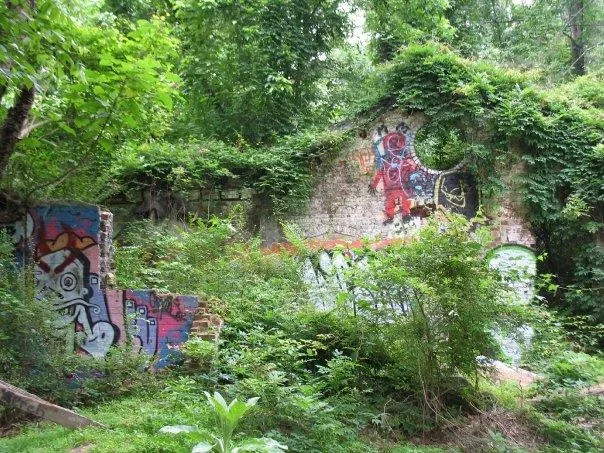
Northeast of downtown Decatur, this 42-acre district preserves the remains of the city's water supply plant and a later public park. Decatur bought the land in 1906, and the waterworks was finished in late 1907 at a cost of about $46,500. It drew from Burnt Fork Creek and South Fork Peachtree Creek, and surviving pieces include a brick administration building, concrete water and settling tanks, a water tower, a pump house, an outfall and two breached dams. In 1939 Works Progress Administration crews added a stone bridge, a fountain, granite benches and picnic areas. The plant served the city until a countywide system was completed in 1942, then remained as a backup. The park closed during World War II and was not revived. The district was listed for its engineering, its role in local government and public works, its recreational use, and its planned landscape. Today the site is wooded, overgrown and unused, surrounded by modern housing.
Significance in brief: The nomination argues the complex is a good example of an early 20th-century city waterworks and an important public works project, significant in engineering, politics and government, entertainment/recreation and landscape architecture. Its stone park features reflect New Deal-era public works and a planned park landscape laid over an industrial one. It is treated as a historic vernacular landscape of local significance.
Machine-generated summary. This summary was generated by a language model from the official nomination document and has not been reviewed line by line by an editor. It may contain errors. Check the source document before relying on any detail. Source: nomination document (PDF) · National Archives catalog entry. NRHP reference 06000123, listed March 15, 2006. Summary generated October 2026 (model claude-sonnet-5-5, prompt v1.0-2026-10-29, confidence high).
Key facts
| Address | 1400 McConnell Dr., Mason Mill Park, Decatur |
|---|---|
| County | DeKalb County |
| Listed | March 15, 2006 |
| Reference number | 06000123 |
| Resource type | District |
| Period of significance | 1906-1955 |
| Architect / builder | Unknown (the history names engineer H. T. Joudon and the contracting firm Walter and Wagner of Rome, Georgia, for the 1907 construction) |
| Criteria |
|
| Areas of significance | Engineering, Entertainment/Recreation, Landscape Architecture, Politics/Government |
| Level of significance | Local |
| Status (as stated in the nomination) | Overgrown, wooded and not currently in use; the dams are breached and the reservoir area is dry. The administration building survives only as remnants. |
| Acreage | 42 |
| Coordinates | 33.80782, -84.30221 (NPS GIS) |
What listing means for this property
This is a historic district. Buildings within its boundary are either contributing (they add to the district's significance) or non-contributing. Owners of contributing income-producing buildings can claim the 20% federal rehabilitation tax credit; homeowners should look at state credits. National Register districts impose no design review by themselves; a local historic district ordinance, if one exists, does (the difference explained).
Noted as vacant in the nomination. Nomination documents can be decades old; current status may differ. If you are considering buying an empty listed property, read the due-diligence checklist.
General information, not legal or tax advice. Rules change; confirm with your State Historic Preservation Office or a qualified adviser.
Sources and further reading
- National Park Service, National Register of Historic Places database (snapshot May 2026), reference 06000123.
- Nomination form (PDF, National Archives) — catalog entry
- Wikipedia article (used for cross-checking only; text not reproduced here)
- Wikidata Q5248816
- This listing as JSON
Last updated October 2026. Found an error? See the editorial policy for how to report it.