Candler Park Historic District

Why it's listed
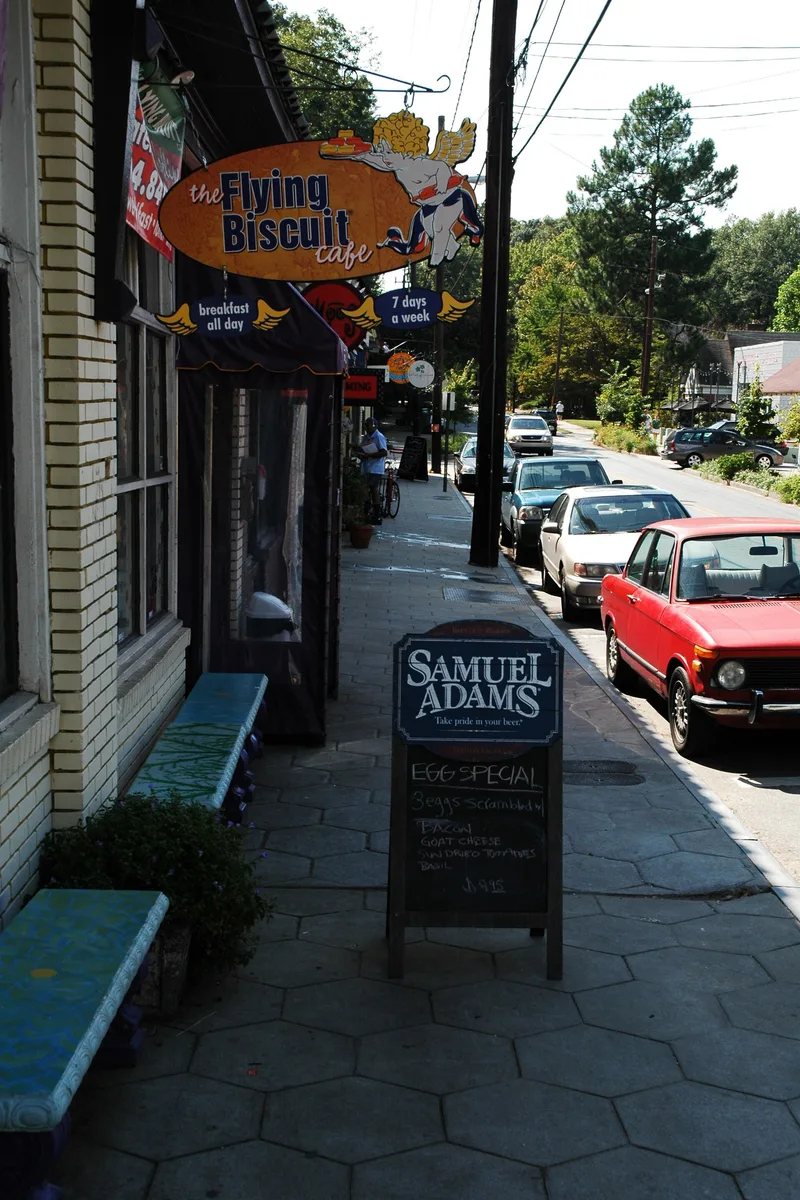
Candler Park Historic District covers roughly 450 acres of in-town Atlanta, built around a city park begun in 1922. The area began as Edgewood, a community that grew along the Georgia Railroad in the 1870s, was incorporated in 1899 and was annexed by Atlanta in 1909. Streetcar lines and later the automobile encouraged growth, and from about 1910 realty companies subdivided land into small lots. The district holds more than one thousand residences, mostly detached, middle-class single-family homes laid out on a gridiron of streets. Late-Victorian cottages and larger houses stand in the west, early transitional bungalows in the center, and brick bungalows from the 1920s and 1930s in the east. Churches, a 1926 school, apartment buildings and corner stores are also present. Informal front yards, street trees, curbs, retaining walls and hexagonal-paver sidewalks add to the setting. The district was listed for its community planning, transportation, architecture and landscape architecture.
Significance in brief: The nomination argues the district shows how metropolitan Atlanta grew, as an independent railroad town became an in-town streetcar suburb. It is also significant for its late-Victorian and Bungalow/Craftsman houses and for turn-of-the-century yard and street landscaping. Transportation by rail, streetcar and automobile shaped its development.
Machine-generated summary. This summary was generated by a language model from the official nomination document and has not been reviewed line by line by an editor. It may contain errors. Check the source document before relying on any detail. Source: nomination document (PDF) · National Archives catalog entry. NRHP reference 83000191, listed September 8, 1983. Summary generated October 2026 (model claude-sonnet-5-5, prompt v1.0-2026-10-29, confidence high).
Key facts
| Address | Roughly bounded by Moreland, DeKalb, McLendon, and Harold Aves., Mathews St., and Clifton Terr., Atlanta |
|---|---|
| County | DeKalb County |
| Listed | September 8, 1983 |
| Reference number | 83000191 |
| Resource type | District |
| Period of significance | Late 19th-early 20th century |
| Architect / builder | Multiple |
| Architectural style | Late-Victorian and Bungalow/Craftsman |
| Criteria |
|
| Areas of significance | Community Planning and Development, Architecture |
| Level of significance | State |
| Status (as stated in the nomination) | Occupied; mostly private residences, with commercial, educational and park uses. Described as in good condition, with non-contributing properties limited to a few modern apartment buildings and non-historic houses. |
| Acreage | 450 |
| Coordinates | 33.76738, -84.33844 (NPS GIS) |
What listing means for this property
This is a historic district. Buildings within its boundary are either contributing (they add to the district's significance) or non-contributing. Owners of contributing income-producing buildings can claim the 20% federal rehabilitation tax credit; homeowners should look at state credits. National Register districts impose no design review by themselves; a local historic district ordinance, if one exists, does (the difference explained).
General information, not legal or tax advice. Rules change; confirm with your State Historic Preservation Office or a qualified adviser.
Sources and further reading
- National Park Service, National Register of Historic Places database (snapshot May 2026), reference 83000191.
- Nomination form (PDF, National Archives) — catalog entry
- Wikipedia article (used for cross-checking only; text not reproduced here)
- Wikidata Q3895380
- This listing as JSON
Last updated October 2026. Found an error? See the editorial policy for how to report it.