Cobbham Historic District
Also known as: See Also:Sledge-Cobb House; Seney-Stovall Chapel

Why it's listed
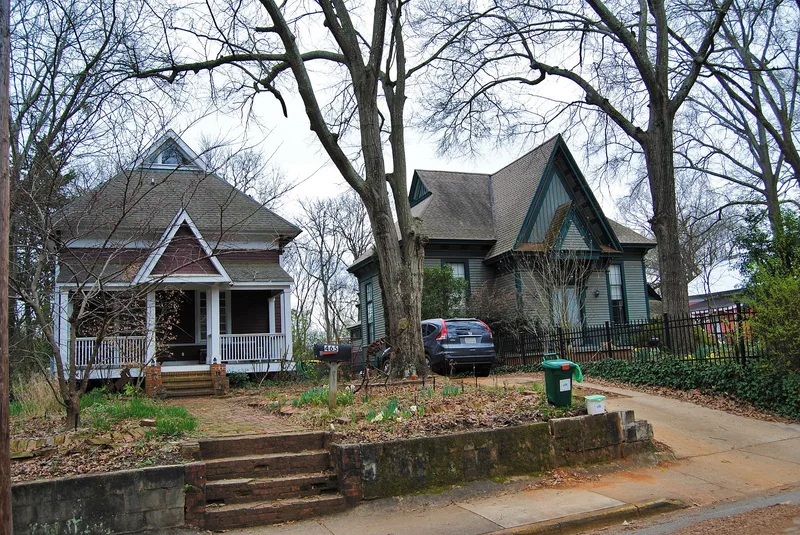
Cobbham is a residential neighborhood northwest of downtown Athens, Georgia, that began in 1834 when John A. Cobb offered 80 lots along the road now called Prince Avenue. Before the Civil War it was almost rural, with large houses and outbuildings filling entire blocks, mostly in Greek Revival style with some Gothic Revival. Growth resumed after the war and accelerated toward the end of the century, leaving a mix of Victorian-era houses, from small frame cottages to large rambling homes with towers, turrets and elaborate porches. Notable buildings include Athens Fire Station No. 2 from 1901, the c. 1850 Cobb-Bucknell House built for Howell Cobb and later moved to its present site, and the c. 1856 Hayes-DeRenne-Spalding House. Development slowed after 1930, then growth since 1950 brought commercial intrusions and strip development. The district was listed because it preserves this layered record of Athens residential architecture and neighborhood development.
Significance in brief: The nomination presents Cobbham as an early Athens neighborhood that grew from a rural setting of a few large antebellum homes into a dense in-town district. Its buildings, from Greek Revival houses to Victorian-era residences and an 1901 fire station, reflect the changing architectural tastes of successive eras. The Howell Cobb residence is among the notable houses.
Machine-generated summary. This summary was generated by a language model from the official nomination document and has not been reviewed line by line by an editor. It may contain errors. Check the source document before relying on any detail. Source: nomination document (PDF) · National Archives catalog entry. NRHP reference 78000973, listed August 24, 1978. Summary generated October 2026 (model claude-sonnet-5-5, prompt v1.0-2026-10-29, confidence medium).
Key facts
| Address | Roughly bounded by Prince Ave., Hill, Reese, and Pope Sts., Athens |
|---|---|
| County | Clarke County |
| Listed | August 24, 1978 |
| Reference number | 78000973 |
| Resource type | District |
| Architectural style | Greek Revival, Gothic Revival and Victorian-era styles |
| Areas of significance | Education, Architecture, Social History |
| Level of significance | State |
| Status (as stated in the nomination) | Condition marked excellent, good, fair and deteriorated; described as altered, on its original site, and subject to increasing commercial and institutional intrusions. |
| Acreage | 117 |
| Coordinates | 33.95881, -83.39083 (NPS GIS) |
What listing means for this property
This is a historic district. Buildings within its boundary are either contributing (they add to the district's significance) or non-contributing. Owners of contributing income-producing buildings can claim the 20% federal rehabilitation tax credit; homeowners should look at state credits. National Register districts impose no design review by themselves; a local historic district ordinance, if one exists, does (the difference explained).
General information, not legal or tax advice. Rules change; confirm with your State Historic Preservation Office or a qualified adviser.
Sources and further reading
- National Park Service, National Register of Historic Places database (snapshot May 2026), reference 78000973.
- Nomination form (PDF, National Archives) — catalog entry
- Wikipedia article (used for cross-checking only; text not reproduced here)
- Wikidata Q49478749
- This listing as JSON
Last updated October 2026. Found an error? See the editorial policy for how to report it.