Savannah Victorian Historic District
Also known as: See Also:Savannah Victorian District (Boundary Increase)

The pin is a point inside the NPS boundary polygon, not a surveyed location.
Why it's listed
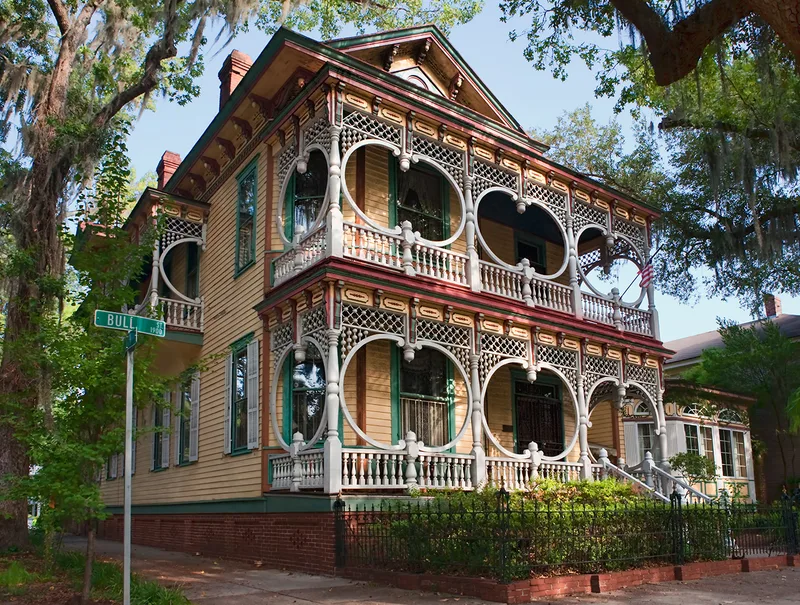
Savannah's Victorian district covers about 45 blocks south of the city's original settlement and adjoins Forsyth Park and its Park Extension, a former military parade ground. Wards and lots were laid out between 1868 and 1872 on land Oglethorpe's plan had designated as farm lots. Street railways made the area workable as Savannah's first suburb, and most building took place between 1870 and 1897. Most houses are two-storey wood Carpenter "Box" dwellings with lace-like wooden trim. The district also has brick row houses with cast iron lintels and later Queen Anne houses with turrets and fine detail. Architects including William Gibbons Preston and A. S. Eichburg designed homes and institutional buildings there, among them Telfair Hospital and the Henry Street School. Many other houses came from the Home Building Company, which used published cottage plans. The district was listed for its concentrated, intact late nineteenth-century middle-class neighborhood, with a tree-lined grid of brick sidewalks and narrow lots.
Significance in brief: The district holds an unusually high concentration of post-Civil War domestic architecture in three styles: Carpenter "Box", brick row houses, and Queen Anne. It was Savannah's first suburb, made possible by the extension of street railways, and it housed hard-working middle-class families. It is also tied to several notable Savannah figures and to work by architects such as William Gibbons Preston and A. S. Eichburg.
Machine-generated summary. This summary was generated by a language model from the official nomination document and has not been reviewed line by line by an editor. It may contain errors. Check the source document before relying on any detail. Source: nomination document (PDF) · National Archives catalog entry. NRHP reference 74000665, listed December 11, 1974. Summary generated October 2026 (model claude-sonnet-5-5, prompt v1.0-2026-10-29, confidence medium).
Key facts
| Address | Roughly bounded by Gwinnett, Price, Anderson, and Montgomery Sts., Savannah |
|---|---|
| County | Chatham County |
| Listed | December 11, 1974 |
| Reference number | 74000665 |
| Resource type | District |
| Period of significance | 1870-1897 |
| Architect / builder | William Gibbons Preston; A. S. Eichburg; Home Building Company (builder of many houses) |
| Architectural style | Carpenter "Box" style, brick row houses with cast iron lintels, and High Victorian Queen Anne |
| Areas of significance | Community Planning and Development, Architecture, Social History |
| Level of significance | National |
| Status (as stated in the nomination) | Described in 1974 as in fair condition, generally run down and in poor repair, with some individual restoration efforts under way and commercial intrusions along the north-south streets. |
| Acreage | 150 |
| Within district | Savannah Victorian Historic District (Boundary Increase) |
| Coordinates | 32.06474, -81.09668 (NPS GIS) |
What listing means for this property
This is a historic district. Buildings within its boundary are either contributing (they add to the district's significance) or non-contributing. Owners of contributing income-producing buildings can claim the 20% federal rehabilitation tax credit; homeowners should look at state credits. National Register districts impose no design review by themselves; a local historic district ordinance, if one exists, does (the difference explained).
General information, not legal or tax advice. Rules change; confirm with your State Historic Preservation Office or a qualified adviser.
Sources and further reading
- National Park Service, National Register of Historic Places database (snapshot May 2026), reference 74000665.
- Nomination form (PDF, National Archives) — catalog entry
- Wikipedia article (used for cross-checking only; text not reproduced here)
- Wikidata Q7427894
- This listing as JSON
Last updated October 2026. Found an error? See the editorial policy for how to report it.