Lawler Hosiery Mill
Also known as: Double Eagle Mill; Maryon Hosiery Mill

Why it's listed
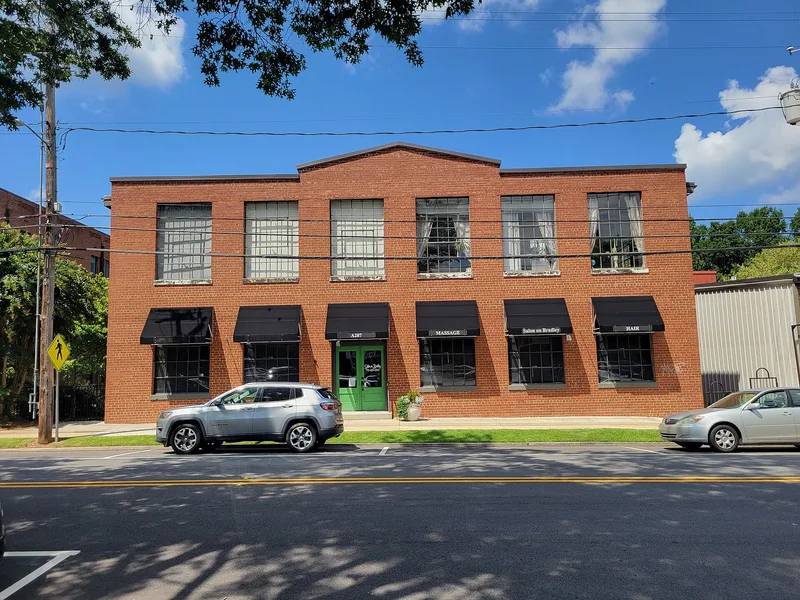
Close to Carrollton's town square, this brick mill complex on Bradley Street was built for hosiery maker Thomas Jackson Lawler. A one-story timber-framed building at the rear, home to the Double Eagle Mill, was operating by 1931. The two-story main mill followed in 1934. It uses slow-burn construction, with load-bearing brick walls, steel posts and beams, maple floors, a shallow-pitched roof, large steel windows and a sprinkler system. Over the decades the site produced socks and, in the 1940s, chenille goods such as bedspreads and rugs. By 1947 it employed about 400 workers, mostly women, and half of wartime production went to the war effort. Its location near downtown meant no mill village was needed. The mill closed in 1995 and was rehabilitated into loft apartments, keeping its framing, brick walls, wood floors and windows. It is recognized for its role in local industry and as an example of early 20th-century Georgia mill design.
Significance in brief: The mill is significant in industry as one of Carrollton's leading employers for most of the 20th century and as a representative of Georgia's textile industry. It is also significant in architecture for its steel-framed, slow-burn construction, which marks a shift in Georgia mill building technology before World War II.
Machine-generated summary. This summary was generated by a language model from the official nomination document and has not been reviewed line by line by an editor. It may contain errors. Check the source document before relying on any detail. Source: nomination document (PDF) · National Archives catalog entry. NRHP reference 04001558, listed January 26, 2005. Summary generated October 2026 (model claude-sonnet-5-5, prompt v1.0-2026-10-29, confidence high).
Key facts
| Address | 301 Bradley St., Carrollton |
|---|---|
| County | Carroll County |
| Listed | January 26, 2005 |
| Reference number | 04001558 |
| Resource type | Building |
| Period of significance | 1931-1954 |
| Architect / builder | Unknown |
| Architectural style | Early 20th-century industrial building |
| Criteria |
|
| Areas of significance | Industry, Architecture |
| Level of significance | Local |
| Status (as stated in the nomination) | Rehabilitated as loft apartments in the late 1990s (certified 2002); current use is multiple dwelling. The mill operated until 1995. |
| Acreage | 2.1 |
| Within district | Carrollton Downtown Historic District |
| Coordinates | 33.57800, -85.07603 (NPS GIS) |
What listing means for this property
For an income-producing building, listing (individually or as a contributing building in a district) is the gateway to the 20% federal rehabilitation tax credit on qualified rehabilitation costs, often stackable with state credits. Work claiming the credit must follow the Secretary of the Interior's Standards and be approved in advance.
Listing does not restrict a private owner acting without federal money or permits; where federal funding or licensing is involved, Section 106 review applies.
General information, not legal or tax advice. Rules change; confirm with your State Historic Preservation Office or a qualified adviser.
Sources and further reading
- National Park Service, National Register of Historic Places database (snapshot May 2026), reference 04001558.
- Nomination form (PDF, National Archives) — catalog entry
- Wikidata Q134135234
- This listing as JSON
Last updated October 2026. Found an error? See the editorial policy for how to report it.