Farmers' High School

Why it's listed
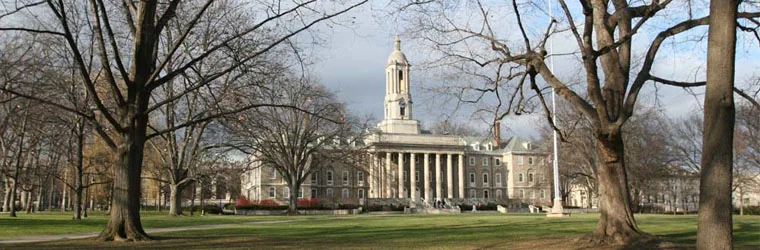
Centered on the Mall and Old Main Lawn at the University Park campus, the Old Campus district gathers buildings from the 1880s through the 1950s in arrangements that follow a planned layout. The Mall runs about 533 yards between Allen Street and the Egyptian Revival portals of Pattee Library. Old Main, rebuilt in 1929 from the original stones, is the campus symbol, with its limestone portico and bell tower. Carnegie Hall and McAllister Hall were completed in 1903 and 1905. West Halls, built between 1922 and 1937 by Charles Klauder, forms a Beaux-Arts quadrangle of three courtyards. The district is significant as a physical record of the school's growth from the Farmers' High School, founded through the Pennsylvania Agriculture Society, into the Pennsylvania State University. Its planned quadrangles and matched styles are also considered important in campus design.
Machine-generated summary. This summary was generated by a language model from the official nomination document and has not been reviewed line by line by an editor. It may contain errors. Check the source document before relying on any detail. Source: nomination document (PDF) · catalog entry. Generated October 2026 (model claude-haiku-5-5, prompt v1.1-2026-10-29).
| Period of significance | 1800-1899 |
|---|---|
| Styles | Georgian Revival, Neoclassic, Romanesque Revival, Dutch Colonial, Beaux-Arts influence, Art Deco, Egyptian Revival |
| Areas of significance | Community Planning and Development, Landscape Architecture, Art, Education, Architecture, Social History, Agriculture |
| Acreage | 82 |
| Boundary source | NPS cultural-resource GIS polygon |
| Full listing page | Farmers' High School (property record) |
What listing means for this property
This is a historic district. Buildings within its boundary are either contributing (they add to the district's significance) or non-contributing. Owners of contributing income-producing buildings can claim the 20% federal rehabilitation tax credit; homeowners should look at state credits. National Register districts impose no design review by themselves; a local historic district ordinance, if one exists, does (the difference explained).
General information, not legal or tax advice. Rules change; confirm with your State Historic Preservation Office or a qualified adviser.