Unionville Historic District

Why it's listed
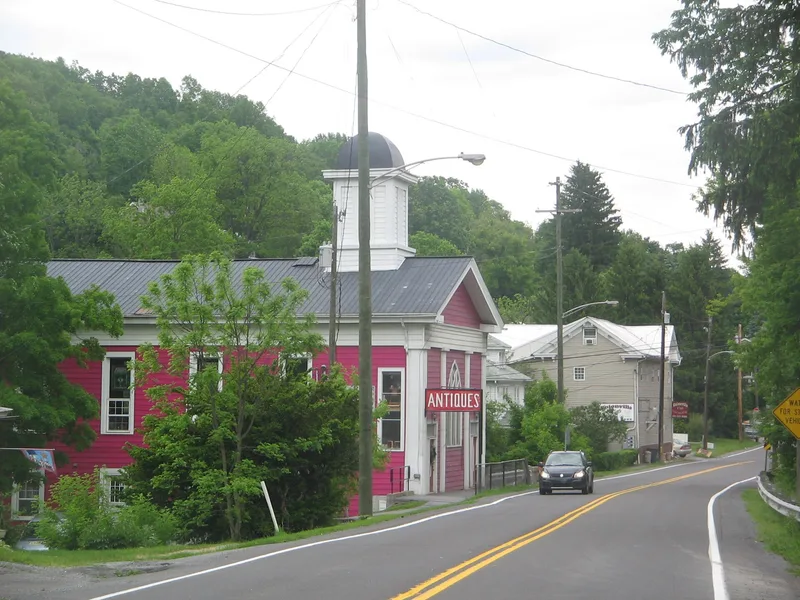
Unionville is a village district in Bald Eagle Valley, Centre County, with about 105 principal structures, most built before World War I and laid out on 60-foot lots along the streets. Its oldest houses are plank I-houses, four bays wide and two stories high, built of two layers of two-inch planks that provide solid walls. The L. C. Peters House, dating to about 1844, is regarded as probably the oldest house in the district. Settlement grew after the Plank Road opened in 1850, when the village became a transportation node and a centre of lumbering, milling and tanning. Later buildings show Greek Revival, Italianate and Gothic Revival details in houses, churches and stores. The district's significance lies chiefly in the concentration of vernacular and folk house types, which together record 19th-century small-town life. William Underwood, a Quaker, was the most important figure in its founding.
Significance in brief: The nomination argues the district is significant as a record of 19th-century settlement and for its high concentration of vernacular and folk house types, especially the plank house, a rare construction method in which two layers of two-inch planks form solid walls. It also cites the village's role as a transportation node on the Plank Road and the Rattlesnake Pike, its lumbering and milling economy, and the influence of William Underwood, a Quaker and the village's founder.
Machine-generated summary. This summary was generated by a language model from the official nomination document and has not been reviewed line by line by an editor. It may contain errors. Check the source document before relying on any detail. Source: nomination document (PDF) · National Archives catalog entry. NRHP reference 79002194, listed May 30, 1979. Summary generated October 2026 (model claude-haiku-5-5, prompt v1.1-2026-10-29, confidence medium).
Key facts
| Address | U.S. 220 and PA 504, Unionville |
|---|---|
| County | Centre County |
| Listed | May 30, 1979 |
| Reference number | 79002194 |
| Resource type | District |
| Period of significance | 1848-1900 |
| Architectural style | Vernacular Georgian I-house, Greek Revival, Italianate, Gothic Revival, Victorian |
| Criteria |
|
| Areas of significance | Transportation, Architecture |
| Level of significance | Local |
| Status (as stated in the nomination) | Most buildings retain their historic character; 21 structures are described as intrusive, including 15 mobile homes, and three sites once held historic structures. |
| Acreage | 120 |
| Within district | Farmers' High School |
| Coordinates | 40.90421, -77.87451 (NPS GIS) |
What listing means for this property
This is a historic district. Buildings within its boundary are either contributing (they add to the district's significance) or non-contributing. Owners of contributing income-producing buildings can claim the 20% federal rehabilitation tax credit; homeowners should look at state credits. National Register districts impose no design review by themselves; a local historic district ordinance, if one exists, does (the difference explained).
General information, not legal or tax advice. Rules change; confirm with your State Historic Preservation Office or a qualified adviser.
Sources and further reading
- National Park Service, National Register of Historic Places database (snapshot May 2026), reference 79002194.
- Nomination form (PDF, National Archives) — catalog entry
- Wikipedia article (used for cross-checking only; text not reproduced here)
- Wikidata Q7886888
- This listing as JSON
Last updated October 2026. Found an error? See the editorial policy for how to report it.