Prospect Hill Historic District

Why it's listed
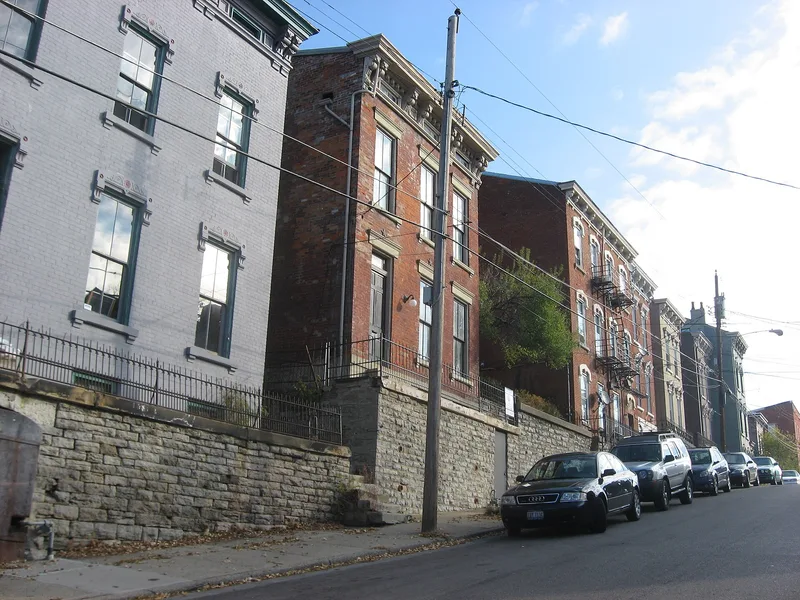
Prospect Hill is a compact residential neighborhood of about 275 buildings climbing the southern slope of Mt. Auburn in Cincinnati. Platted in 1830 by Boal and Slack, it was the first of the city's hillsides to be settled. Its tall, narrow brick houses sit on lots only 25 to 30 feet wide and follow the slope, with retaining walls, stairways and unbuilt "paper streets" reflecting the steep terrain. Greek Revival houses from about 1839 to 1850 mark the earliest phase, Italianate rows from the 1860s and 1870s dominate, and Queen Anne buildings from 1880 to 1895 cluster in the northeast. Landmarks include the 1867 First District School and the George Pendleton House, a National Historic Landmark. Settlers of English descent gave way to German immigrants from about 1840, and the ward was around 70 percent German in 1890. The district is valued for its consistent scale, materials and sense of place.
Machine-generated summary. This summary was generated by a language model from the official nomination document and has not been reviewed line by line by an editor. It may contain errors. Check the source document before relying on any detail. Source: nomination document (PDF) · catalog entry. Generated October 2026 (model claude-sonnet-5-5, prompt v1.0-2026-10-29).
| Period of significance | circa 1830 - present |
|---|---|
| Styles | Greek Revival, Italianate, Queen Anne |
| Areas of significance | Architecture |
| Acreage | 36 |
| Boundary source | NPS cultural-resource GIS polygon |
| Full listing page | Prospect Hill Historic District (property record) |
What listing means for this property
This is a historic district. Buildings within its boundary are either contributing (they add to the district's significance) or non-contributing. Owners of contributing income-producing buildings can claim the 20% federal rehabilitation tax credit; homeowners should look at state credits. National Register districts impose no design review by themselves; a local historic district ordinance, if one exists, does (the difference explained).
General information, not legal or tax advice. Rules change; confirm with your State Historic Preservation Office or a qualified adviser.