Fayetteville Street Historic District

Why it's listed
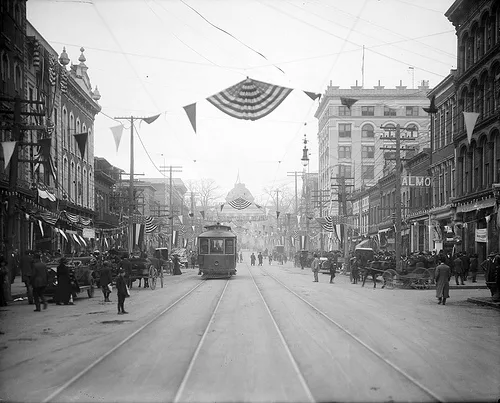
Fayetteville Street is Raleigh's main commercial corridor, and this district takes in four blocks of it along with a few buildings on West Hargett, West Martin and South Salisbury Streets. The district has 21 contributing and 8 noncontributing resources. The buildings range from four-story brick stores to steel-framed skyscrapers of up to sixteen stories. The period of significance begins in 1874 with Briggs Hardware and the Second Empire Post Office and Courtroom, and ends in 1965 with three modernist bank buildings. Together these show the street's growth from a retail corridor of shops, banks and theaters into a center of corporate banking. The 1909 Masonic Temple, designed by Charles McMillan, was the state's first skyscraper with a steel-reinforced concrete frame. Many older storefronts were remodeled before 1965, and the district counts those changes as part of the buildings' history. Later infill from the 1970s and 1980s is classed as noncontributing. Uses today include offices, restaurants, apartments, a museum and government functions.
Machine-generated summary. This summary was generated by a language model from the official nomination document and has not been reviewed line by line by an editor. It may contain errors. Check the source document before relying on any detail. Source: nomination document (PDF) · catalog entry. Generated October 2026 (model claude-sonnet-5-5, prompt v1.0-2026-10-29).
| Period of significance | 1874-1965 |
|---|---|
| Styles | Late Victorian (Italianate, Second Empire); Classical Revival; Commercial Style; Skyscraper; Moderne; International Style; Art Deco; Brutalism |
| Areas of significance | Architecture, Commerce |
| Acreage | 12 |
| Boundary source | NPS cultural-resource GIS polygon |
| Full listing page | Fayetteville Street Historic District (property record) |
What listing means for this property
This is a historic district. Buildings within its boundary are either contributing (they add to the district's significance) or non-contributing. Owners of contributing income-producing buildings can claim the 20% federal rehabilitation tax credit; homeowners should look at state credits. National Register districts impose no design review by themselves; a local historic district ordinance, if one exists, does (the difference explained).
General information, not legal or tax advice. Rules change; confirm with your State Historic Preservation Office or a qualified adviser.