Galesburg Historic District

Why it's listed
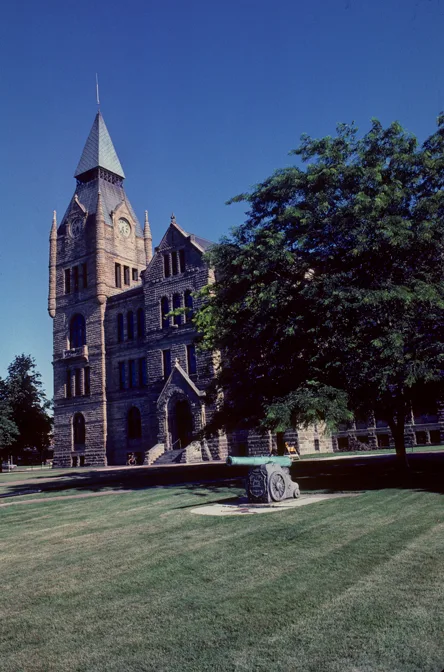
Galesburg's historic district takes in about 496 acres of the central city in Knox County, Illinois. It includes most of the original town plat, a large part of the Knox College campus, and older residential neighborhoods, mostly north of North Street. Of 1,128 structures counted, 111 were judged especially significant. The city began in 1836 as a colony planned by George Washington Gale to support a Christian college on the prairie. Knox College's Old Main, completed in 1857, hosted the fifth Lincoln-Douglas Debate on 7 October 1858 and remains the only debate site unchanged since then. The arrival of the Chicago, Burlington and Quincy Railroad in 1854, followed by the Santa Fe in 1887, brought industry, Swedish immigrants and wealth. That wealth produced the Queen Anne, Neo-Classical and other residences along Prairie, Cherry, Broad and Academy streets, most built around 1890-1905. Main Street and the campus supply the larger landmark buildings in the south.
Machine-generated summary. This summary was generated by a language model from the official nomination document and has not been reviewed line by line by an editor. It may contain errors. Check the source document before relying on any detail. Source: nomination document (PDF) · catalog entry. Generated October 2026 (model claude-sonnet-5-5, prompt v1.0-2026-10-29).
| Styles | Mixed styles, mainly Queen Anne, Neo-Classical/Classical Revival, Gothic, Second Empire, Romanesque and Italianate, with the dominant fabric from ca. 1890-1905 |
|---|---|
| Areas of significance | Education, Exploration/Settlement, Architecture |
| Acreage | 496 |
| Boundary source | NPS cultural-resource GIS polygon |
| Full listing page | Galesburg Historic District (property record) |
What listing means for this property
This is a historic district. Buildings within its boundary are either contributing (they add to the district's significance) or non-contributing. Owners of contributing income-producing buildings can claim the 20% federal rehabilitation tax credit; homeowners should look at state credits. National Register districts impose no design review by themselves; a local historic district ordinance, if one exists, does (the difference explained).
General information, not legal or tax advice. Rules change; confirm with your State Historic Preservation Office or a qualified adviser.