Squatter's Cabin

Why it's listed
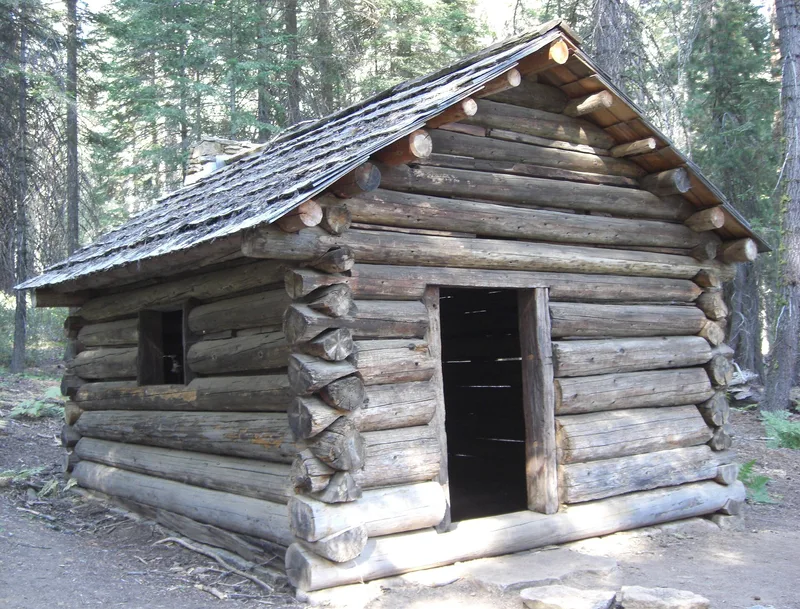
Squatter's Cabin is a small one-room log building set in a grove of giant sequoias at the north end of Huckleberry Meadow, in the Giant Forest of Sequoia National Park. It measures about 14 by 16 feet and has peeled, horizontal log walls, mostly white fir, with notched corners, a dry-masonry chimney and fireplace, a shake gable roof and a dirt floor. John Vest, a schoolteacher and member of the Kaweah Cooperative Commonwealth, built it around 1886. The colony was a socialist group hoping to create a utopian community based on logging, and its members filed timber claims on Giant Forest land. Vest soon learned that the meadow tract had already been sold to Hale Tharp, the pioneer resident of Giant Forest, so he abandoned both claim and cabin. Regular habitation is not recorded afterward. The cabin was apparently a trailside museum in the 1930s and is now empty. It survives as one of the few remnants of the Kaweah Colony and one of the oldest buildings in the park.
Significance in brief: It is one of the few known surviving structures of the Kaweah Colony, a socialistic enterprise of the late 1880s, and one of the oldest buildings remaining in Sequoia National Park. The nomination treats it as regionally significant in exploration/settlement and social/humanitarian endeavor.
Machine-generated summary. This summary was generated by a language model from the official nomination document and has not been reviewed line by line by an editor. It may contain errors. Check the source document before relying on any detail. Source: nomination document (PDF) · National Archives catalog entry. NRHP reference 77000116, listed March 8, 1977. Summary generated October 2026 (model claude-sonnet-5-5, prompt v1.0-2026-10-29, confidence medium).
Key facts
| Address | NE of Three Rivers, Three Rivers |
|---|---|
| County | Tulare County |
| Listed | March 8, 1977 |
| Reference number | 77000116 |
| Resource type | Building |
| Period of significance | Built ca. 1886 |
| Architect / builder | John Vest |
| Areas of significance | Exploration/Settlement, Social History |
| Level of significance | Local |
| Status (as stated in the nomination) | The cabin has been restored at an undetermined date. It was apparently used as a trailside museum in the 1930s and now stands empty. The site is reachable only by park trail. |
| Acreage | 0.6 |
| Coordinates | 36.55868, -118.75357 (NPS GIS) |
What listing means for this property
National Register listing is honorary for a privately owned home: it does not by itself restrict what an owner may do with their own money, and it does not require public access. Restrictions come from local landmark or historic-district ordinances, which are separate (how they differ).
Owner-occupied houses are not eligible for the 20% federal rehabilitation tax credit, which applies to income-producing buildings, but many states offer credits for homeowners. Listing also opens the door to preservation easements and to buying a plaque. Start with what listing means for homeowners, renovating a listed house and selling one.
Noted as vacant in the nomination. Nomination documents can be decades old; current status may differ. If you are considering buying an empty listed property, read the due-diligence checklist.
General information, not legal or tax advice. Rules change; confirm with your State Historic Preservation Office or a qualified adviser.
Sources and further reading
- National Park Service, National Register of Historic Places database (snapshot May 2026), reference 77000116.
- Nomination form (PDF, National Archives) — catalog entry
- Wikipedia article (used for cross-checking only; text not reproduced here)
- Wikidata Q7582158
- This listing as JSON
Last updated October 2026. Found an error? See the editorial policy for how to report it.